Today Was Supposed To Be “Doomsday”
The world was supposed to end today, on a scientist’s birthday. Why are you still scared of all of these dated predictions that keep passing us by?

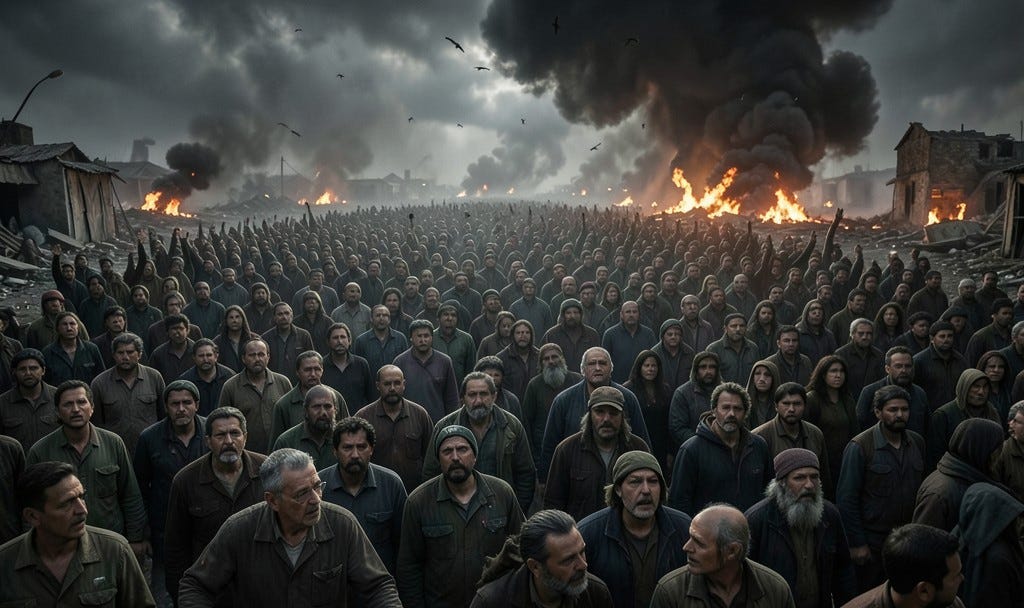
The world was scheduled to end today.
On Friday, November 4, 1960, the journal Science published a paper by Heinz von Foerster and two of his students, Patricia Mora and Lawrence Amiot. Its title was “Doomsday: Friday, 13 November, A.D. 2026.”
So if you’re reading this at 7 PM Eastern, congratulations. You beat the math.
What did the 1960 doomsday paper say?
Von Foerster was a professor and an expert in cybernetics. The mathematician Norbert Wiener named the field in 1948 and defined it in the subtitle of his book Cybernetics as the study of ‘control and communication in the animal and the machine.’ It looks at how a system, whether it’s a machine, a body, or a whole society, takes in information about what it just did and uses that information to control what it does next.
Von Foerster and his students took 24 estimates of world population covering roughly the last 2,000 years and fit an equation to them. The equation showed population growing faster than exponentially. Exponential growth doubles at the same pace each iteration. This curve doubled faster and faster, and if you followed it out, it shot up to infinity on one particular day: Friday, November 13, 2026.
The three of them didn’t think the planet was going to fill up with an infinite number of people on a Friday the 13th. Infinity in an equation means the trend can’t keep going, and something has to give. “They will be squeezed to death” was how they put it. Their solution was “cutting the birth rate to about half its present value.”
And I love this detail: November 13 was von Foerster’s birthday. He was born in Vienna on November 13, 1911. The math itself only gave a year, 2026.87, give or take five and a half years, and .87 of a year works out to the middle of November, so the exact day was his pick.
Sciencing says that “Supposedly, in an attempt at humor, von Foerster selected his birthday.” So he put the end of the world on his own birthday and then published it in Science. (I can’t decide whether that’s a power move or a cry for help. Maybe both.)
Who was Heinz von Foerster?
In 1958, he founded the Biological Computer Laboratory at the University of Illinois, and the history of the lab posted on the BCL’s own archive site says “the U.S. Air Force and the U.S. Navy were the main financial supporters of the laboratory.” Before that, he was the youngest core member of the Macy conferences on cybernetics, and he edited five volumes of their proceedings, published as Cybernetics, from 1949 to 1953, with Hans-Lukas Teuber and Margaret Mead.
The Macy conferences were run by the Josiah Macy Jr. Foundation, and that foundation turns up in the story of MKUltra, the CIA’s mind control program, which I wrote about in my Ewen Cameron article on November 4. The allergist Harold Abramson did LSD research with CIA money in the 1950s. John Marks, in his 1979 book The Search for the “Manchurian Candidate,” calls the Macy Foundation “the sometime Agency conduit,” and he writes that Abramson first turned on Frank Fremont-Smith, “head of the Macy Foundation which passed CIA money to Abramson.” Marks also says Abramson gave Gregory Bateson, one of the regulars at the Macy cybernetics meetings, his first LSD.
The American Society for Cybernetics’ summary of the Macy conferences lists Abramson as a guest at the sixth conference, March 24 and 25, 1949, in New York, and that’s the same meeting where von Foerster gave his talk on memory and got asked to edit the proceedings.
Other threads run through John Lilly, the dolphin researcher. According to the literature professor Bruce Clarke, Lilly’s 1967 report on his own LSD experiments in the isolation tank, written for his NIMH fellowship, “cites substantial passages from Heinz von Foerster’s 1962 paper ‘Bio-Logic.’”
The German filmmaker Lutz Dammbeck also put von Foerster on camera for his 2003 documentary The Net, which is about the Unabomber, LSD, and the internet, but von Foerster talks about systems theory, and the CIA and LSD parts are about Henry Murray, Timothy Leary, and Ted Kaczynski.
The doomsday paper tells you who paid for it: “This study was sponsored in part by the National Institutes of Health, Bethesda, Md. (grant No. C-4044).” (Interesting number.) The man who parked the end of the world on his birthday came up through the meetings where the science of steering systems got started, paid for by a foundation the CIA used to move money, with the Pentagon funding his lab. (Nothing to see here, folks.)
Did anyone take it seriously?
They did. According to the historian Alan MacEachern, mathematicians and demographers wrote letters to the editor of Science calling it “ridiculous” and “manifestly absurd,” and the equation still “became regularly cited,” “usually at face value,” “in textbooks on genetics, ecology, and demography.” In 1963, a witness from the chemical industry cited it to a committee of the Canadian Parliament as the reason chemical pesticides were needed to feed all the people on the way. (I really hope somebody on that committee knew about the birthday. You could have learned that equation out of a textbook and never once heard that part.)
MacEachern also writes that the forecast tracked the real population numbers until about 1993, when the world started falling behind it, “because the world began to do what von Foerster and his colleagues recommended it do,” and that the global birth rate today is “slightly less than half the 1960 rate,” which is almost exactly the cut von Foerster asked for.
MacEachern reads that as the warning working. Scott Alexander pointed out in 2019 that 1960, the year the paper came out, “ironically was the last year that his equations held true.” (Of all the years for it to quit working.)
So the curve was already bending when the paper came out, and the birth rate got cut anyway. How it got cut is the part the textbooks tend to leave out.
What did governments do with numbers like these?
The next big forecast came out of the same field von Foerster worked in. In 1972, a team at MIT published The Limits to Growth for the Club of Rome, a private group of scientists, economists, and business leaders founded in Rome in 1968. Matt Ridley wrote in 2015 that the book “used control system theory to project ecological disaster as a consequence of global population growth.”
In 2024, I called The Limits to Growth “the basis for all of the subsequent WEF bullshit. It’s the bullshit bible, basically.” All of the propaganda that the population crisis fear narratives are based upon originate with this book, and other fear-based false crises have been generated as offshoots from this material as well, in keeping with this destructive mode of thinking, built upon arguments which, as you’ll see here, are ultimately genocide posing as virtue and heroics when taken to their most illogical forgone conclusions.
In 1978, a Chinese guided-missile designer named Song Jian went to a conference on control systems in Helsinki. According to Ridley, that’s where Song came across The Limits to Growth. The anthropologist Susan Greenhalgh, in a 2005 paper in The China Quarterly called “Missile Science, Population Science,” writes that from 1978 to 1980, Song adapted “the work of the Club of Rome” and worked to “persuade China’s leaders that his ‘scientific’ solution was the only way out.” China launched the one-child policy in 1980.
Ridley lists what that solution looked like: “Mandatory sterilisations, mandatory abortions, mandatory insertion of intra-uterine devices.” The historian James Carter quotes Greenhalgh’s description of the 1983 campaign: “sterilizing one member of all couples with two or more children and aborting all unauthorized pregnancies.”
Not everyone accepts the Helsinki story. The Italian scientist Ugo Bardi calls the link between the Club of Rome and Song a legend, and he says the 1978 congress had no session on population and no Club of Rome members among its speakers. In a 2025 update, Bardi confirms Song was at the congress and built a world model of his own. Whichever version you take, a missile scientist ran human beings through a computer model, and a government used his numbers to justify forced sterilizations and abortions.
Paul Ehrlich’s book The Population Bomb came out in 1968, and the revised edition opens with this: “The battle to feed all of humanity is over. In the 1970s and 1980s hundreds of millions of people will starve to death in spite of any crash programs embarked upon now.” A few lines later, he calls for population control at home “by compulsion if voluntary methods fail.” The famine of hundreds of millions he promised never came.
India got the compulsion. In 1965, according to MEL Magazine, President Lyndon Johnson refused food aid to India, which was facing famine, until it agreed to push sterilization. The historian Matthew Connelly quotes Johnson: “I’m not going to piss away foreign aid in nations where they refuse to deal with their own population problems.” Robert McNamara, as president of the World Bank, said the bank wouldn’t finance health care “unless it was very strictly related to population control.” Then, during Indira Gandhi’s state of emergency in the mid-1970s, Connelly writes, “Over 12 months, the government carried out more than eight million sterilizations,” and “According to official statistics, 1,774 people died because of botched operations.” In one village MEL describes, every man over 15 was ordered to the high school, and almost 250 were sterilized.
The United States wrote its own interest down. In 2023, in “The Sun, The Soil, and The Seed,” I wrote about Henry Kissinger’s National Security Study Memorandum 200, also called NSSM 200. Kissinger signed it on April 24, 1974, and sent it to the Secretary of Defense, the Secretary of Agriculture, the Director of Central Intelligence, and the head of USAID, asking how world population growth would affect “U.S. Security and Overseas Interests.” The study that came back says, “The U.S. economy will require large and increasing amounts of minerals from abroad, especially from less developed countries.” It lays out a view that “mandatory programs may be needed.” And the cover memo that sent it up in December 1974 says, “All U.S. efforts should be undertaken in such a way as to minimize criticism.”
Peru came later. According to The Conversation, Alberto Fujimori’s government “sterilized 272,028 people between 1996 and 2001” as part of a “family planning” policy, some of them “without consent.”
Who wanted fewer people?
Julian Huxley, the biologist and brother of Aldous Huxley, became the first director-general of UNESCO in 1946. That year, in the document laying out UNESCO’s philosophy, he wrote that “any radical eugenic policy will be for many years politically and psychologically impossible,” but that “it will be important for Unesco to see that the eugenic problem is examined with the greatest care,” “so that much that now is unthinkable may at least become thinkable.” In 1957, in his book New Bottles for New Wine, he published an essay called “Transhumanism,” the name the movement to push human beings past their biological limits still goes by.
Bertrand Russell, in The Impact of Science on Society, wrote that “the population of the globe is increasing at the rate of about 20 millions a year,” and then: “This is an explosive situation. Left to itself, it must lead to a food shortage and thence to a world war.”
In 2023, in "The Sun, The Soil, and The Seed," I wrote that Thomas Malthus's writings on overpopulation "laid the groundwork for eugenics and social control policies to cull the masses," and that "the Rockefeller Foundation funded eugenics research and population control initiatives across the world."
Here’s what I think ties these together. There is a transhumanist agenda to reduce the population of humanity so that when life extension arrives and people start living to 150+, there’s less competition for resources. A lot of the papers that come out are meant to scare people out of having children, so that over time there will be fewer people to compete with for a monopoly on those resources.
The transhumanists have written about this themselves. Nick Bostrom, the Oxford philosopher who co-founded the World Transhumanist Association, takes up the question “Will extended life worsen overpopulation problems?” in The Transhumanist FAQ, published in 2003. He writes, “The only long-term method of assuring continued growth of average income is some form of population control.” Max More, who founded the Extropian movement, wrote in 1998 that “The population growth is determined by how many children we have, not how long we live.” So if people stop dying, the number left to control is births.
Steve Fuller, a sociologist at the University of Warwick and an affiliate scholar at the Institute for Ethics and Emerging Technologies, was asked in 2015 for his own suggestions about future overpopulation. If we can “affordably repair the telomeres of genes,” he asked, “Why have children at all, then?” One of his suggestions was “to remove all criminal sanctions against suicide, and in fact provide incentives for people to participate in outlets that would enable the transfer what has been meaningful in their lives to a digital medium, where they could enjoy a posthumous ‘virtual’ existence indefinitely.” Another was to “revive the old eugenics policy of providing incentives” for “otherwise barren people to have offspring,” because, he said, “I’m much less worried by the ‘wrong people’ breeding than with the ‘right people’ not breeding.”
In 2017, Yuval Noah Harari wrote that “The most important question in 21st-century economics may well be: What should we do with all the superfluous people,” and that the “‘useless class’ will not merely be unemployed.” He said they’ll be “unemployable.”
Bostrom and More both argue against holding back life extension, and More says technology and markets can handle a bigger population.
What were the Georgia Guidestones?
In 1980, a man calling himself Robert C. Christian paid for a granite monument in Elbert County, Georgia. Its first instruction was to “maintain humanity under 500,000,000.” The second was to “guide reproduction wisely, improving fitness and diversity.” In 2022, I wrote that the Guidestones “catalog the depopulation agenda in plain sight.” A few months before that, in 2021, I put it this way: “According to the nightmarish Machiavellian inscription on the Guidestones, only 500 million people are meant to survive.”
A candidate for governor of Georgia, Kandiss Taylor, made tearing them down part of her 2022 platform. Before dawn on July 6, 2022, a bomb blew one panel to rubble, and the rest of the monument was knocked down “for safety reasons” afterward. A year later, Fox 5 Atlanta reported that the bomber “has still not been identified or captured by police,” and I haven’t found a report since that names anyone. The monument that told the world to keep humanity under half a billion is gone, and so far, no one has been charged with destroying it.
Are the population counts even right?
Many researchers question whether the world’s population numbers are real at all. Yi Fuxian, a senior scientist at the University of Wisconsin-Madison, argues that China’s population in 2020 “probably amounted to about 1.28 billion,” which is “some 130 million fewer people than reported,” and that local governments padded school enrollment numbers to get more education money.
In October 2026, Yi published a monograph arguing that China’s actual population “may be closer to 1.27 billion” than the 1.4 billion it reports. He compares China’s BCG vaccine approvals with the births it reports, and they don’t match. He also follows the children born in 2000 and finds about 3.5 million fewer of them in the 2010 census and the 2015 school data than the official birth count says there should be.
Others go much further. Lei, who grew up in China and now runs the YouTube channel Lei’s Real Talk, said on the Man in America podcast in May 2025 that she believes China’s population is “somewhere under 500 million.” The write-up of that episode doesn’t show her math, so I can’t check it from here. On their podcast Based Camp, Malcolm and Simone Collins cite a Russian expert and a Japanese study that put China near 800 million, a study of salt sales that comes out “31% lower than official data,” and a 47 percent drop in Lunar New Year trips between 2019 and 2023. Malcolm Collins thinks the world’s population is “dramatically lower than anyone thinks it is.”
For a lot of countries, nobody knows. In January 2026, the writer David Oks published “A lot of population numbers are fake,” and wrote, “we simply have no idea how many people live in many of the world’s countries.” Papua New Guinea’s government said it had 9.4 million people in 2022, working from a census taken in 2000, and a UN-commissioned report reportedly put the number near 17 million before the UN shelved it. Nigeria’s official 240 million rests on a 2006 census, and the head of its own population commission said “no census has been credible in Nigeria since 1816.” The Democratic Republic of the Congo hasn’t held a census since 1984. Estimates for Eritrea “vary by a factor of two.” Oks himself thinks the errors in different countries roughly cancel out, and he doesn’t believe the world total is off by billions. He also says the most credible estimates put China’s overcount at only a few percentage points.
A 2025 study in Nature Communications, led by Josias Láng-Ritter at Aalto University in Finland, checked five global population datasets against more than 300 rural dam projects in 35 countries. It found rural populations may be undercounted by “as much as 53% to 84%.” So one researcher says a country has fewer people than reported, and another says the countryside has more. Both of them are telling you the counts are estimates, and von Foerster built his curve out of 24 estimates going back 2,000 years.
Where are all the people?
In 2021, I wrote a piece called “What No One Is Asking: Where Are All The People?” Employers all over the world couldn’t fill jobs, and I asked, “Why isn’t anyone asking WHY?”
The United Nations’ own 2024 projections say world population will peak “around 10.3 billion in the mid-2080s” and then shrink. “As of 2024, population size has peaked in 63 countries and areas,” including China, Germany, Japan, and Russia. In more than half of all countries and areas, “the average number of live births per woman is below 2.1,” which is the rate a population needs to replace itself.
In 2024, I wrote, “We are NOT headed into this The Limits To Growth cultist style overpopulation scenario that has been fed to us by academics since 1972 who keep pushing this narrative because they desperately want to retain their research funding year over year.” And I wrote, “This false overpopulation narrative has been crafted to appeal to your fear and to manipulate your sense of altruism so that you will willingly give up what you have for the ‘greater good’ of the group.”
Where does the Great Reset come in?
The Limits to Growth went straight to Davos. The World Economic Forum started in February 1971 as the European Management Forum, a conference Klaus Schwab organized in the Swiss Alps. According to the Forum’s own history, at the 1973 meeting, “Aurelio Peccei, the Italian industrialist, delivered a speech on his book ‘The Limits to Growth.’” Peccei co-founded the Club of Rome, the group that commissioned the book.
In 1991, the Club of Rome’s council published The First Global Revolution. The passage people quote from it, usually cited as page 75 of the first edition, reads: “In searching for a new enemy to unite us, we came up with the idea that pollution, the threat of global warming, water shortages, famine and the like would fit the bill.” A few lines later: “The real enemy then is humanity itself.”
In 2016, the Forum published “8 predictions for the world in 2030.” The first one, from the Danish politician Ida Auken, is written as if the speaker is already in 2030: “I don’t own anything. I don’t own a car. I don’t own a house.” Another prediction says “climate change will have displaced 1 billion people.” In 2022, I wrote that the Forum’s climate story, “if acted upon by the public in earnest,” would create “A HERD OF CLIMATE REFUGEES MOVING IN THE WRONG DIRECTION” who would then be “beholden to the totalitarian state for food security.”
On June 3, 2020, three months into the pandemic, Schwab published “Now is the time for a ‘great reset,’” and wrote that “the pandemic represents a rare but narrow window of opportunity to reflect, reimagine, and reset our world.” The crisis came first, and the reset was ready for it.
In 2021, in “Things I Can’t Say, Part Three: El Salvador Is A Trap,” I wrote about Schwab’s Young Global Leaders program, which trains a “class” every year, and I published a list of its alumni. Jeff Bezos is on it. So are Tony Blair, Jacinda Ardern, and Google co-founder Sergey Brin.
Who was Brin married to?
Nicole Shanahan, a California lawyer and investor, married Brin in 2018, and their divorce was announced in 2022. She founded the Bia-Echo Foundation, whose focus areas include reproductive longevity and equality, criminal justice reform, and environmental sustainability. In March 2024, Robert F. Kennedy Jr. picked her as his running mate.
Shanahan said what follows on Relatable with Allie Beth Stuckey, a Christian podcast, in a long interview recorded after her baptism in January 2025. A four-minute clip from it started making the rounds on X at the end of November 2025. She says that “what I don’t think many of the tech mafia wives realize is that they were used to set the groundwork for what was called like the reset.” Then she calls it “the great reset,” and says, “They I mean they openly talk about this great reset.” She says the wives’ money “especially was being conscripted” to “set the groundwork for the great reset,” through “NGO advisors,” Hollywood, “Davos and their own companies.” She says, “It’s a really small group of people making these decisions.”
Then she holds up a mirror to her own giving. “I really believe that I was helping indigenous communities rise up out of oppression,” she says, and when she looks back at how the grants performed, “the problems of the community have gotten worse.” She says “many of our climate change issues are geoengineering issues,” and that when you push back, “They’re like, ‘But climate change.’” The clip ends on this exchange: “Social justice and climate change. It always boils down to those two things. And it gets progressive women 100% of the time.”
She describes what that money actually built. “The NGO thrived,” she says. “They need the communities to remain in bad shape to raise more money.” Earlier in the interview, she says progressives’ “empathy and compassion is being used.” That’s what I wrote in 2024 about the overpopulation story, that it was built “to manipulate your sense of altruism.”
What did she say about fertility?
Shanahan says she’s “the largest donor in women’s reproductive longevity,” and that she put “$100 million into women’s reproductive longevity.” She says the first group that tried to move into the field “was trying to create eggs out of skin cells.”
In September 2025, researchers at Oregon Health & Science University reported in Nature Communications that they had turned human skin cells into eggs, using a technique they call “mitomeiosis.” They fertilized 82 of the eggs. About 9 percent developed to the blastocyst stage, and most of the rest showed chromosomal abnormalities.
She calls lab-made embryos, embryo selection, and gene editing “all eugenics,” and “the dream of eugenics.” Stuckey, her host, says the eugenicists “were behind Planned Parenthood, too.” In 2020, Planned Parenthood of Greater New York took Margaret Sanger’s name off its Manhattan clinic. NBC News reported the reason as Sanger’s “well-documented connections with the eugenics movement,” and the board chair, Karen Seltzer, spoke of Sanger’s “racist legacy.”
Shanahan also says the theory people got called crazy for was that the vaccine was “a depopulation, you know, program,” and she says, “Well, it actually has caused depopulation. Whether or not it was intentional, we’ll find out.” She says “one of the scientific definitions of extinction is the inability to naturally procreate,” and that by that measure, “the human species is going extinct.”
Hormonageddon: How Chemical and Electromagnetic Influences Weakened the Human Character in Three Generations is Sacha Dobler’s 2021 book. I urged everyone to read it back then. I think it would still be helpful to do so. In 2024, I wrote that “sperm count has been steadily declining by 1-2% year over year for so long that, by 2045, the median sperm count will be zero,” and that “Those calculations from Hormonageddon came from data collected BEFORE the advent of the shots.”
Shanna Swan, an epidemiologist at Mount Sinai, makes the same projection in her 2021 book Count Down. She told Axios that year that if you “project it forward,” which she called “always risky,” the curve “reaches zero in 2045.” The same warning applies to von Foerster’s infinite population curve.
Is geoengineering real?
On May 18, 1977, in Geneva, the United States, the Soviet Union, and other countries signed the Convention on the Prohibition of Military or Any Other Hostile Use of Environmental Modification Techniques, known as ENMOD. Every country that joins promises “not to engage in military or any other hostile use” of techniques for changing the environment that have “widespread, long-lasting or severe effects.” The U.S. Senate approved it 98 to 0 in 1979, and it took effect for the United States on January 17, 1980.
Why sign a treaty to prevent something nobody could do? We already could.
On November 13, 1946, 80 years ago today, a General Electric scientist named Vincent Schaefer dropped dry ice from a plane into the clouds over Mount Greylock in western Massachusetts, and it snowed. The next October, under Project Cirrus, GE and the U.S. military seeded a hurricane off the coast of Florida. According to The Black Vault, which posted the project’s reports, the hurricane “abruptly changed course and made landfall in Georgia.” It’s still “uncertain whether the seeding caused the change in direction,” but the “public outcry and legal threats” got the project “temporarily halted.”
Then came the war. In March 1974, at a secret Senate subcommittee hearing that Senator Claiborne Pell pushed for, the Pentagon admitted it had run a rainmaking program over Indochina from March 1967 to July 5, 1972. It was called Operation Popeye. According to Nature, a Pentagon witness testified that the military flew 2,602 cloud-seeding missions over Laos, Cambodia, and North and South Vietnam, using 47,409 canisters of silver and lead iodide, to turn the roads and jungle trails of the Ho Chi Minh Trail into mud. The Defense Intelligence Agency estimated that rainfall rose as much as 30 percent above predicted levels in the areas they seeded. It cost about $3.6 million a year. Pell said “this new kind of weaponry should be eschewed.” Three years later, the treaty was signed.
At home, it never stopped. In 1971, Congress passed a law requiring anyone who does weather modification in the United States to report it to NOAA, the National Oceanic and Atmospheric Administration. In February 2026, the Government Accountability Office reported that as of July 2025, “10 states had reported weather modification activities.” It also found that NOAA “does not assess weather modification reports for scientific validity or accuracy,” and that “over half of all the reports filed with NOAA likely have errors.” Four of the 1,084 files in NOAA’s public database described solar geoengineering. Florida, Louisiana, and Tennessee have banned weather modification, and 29 other states have proposed some form of ban.
On August 11, 1987, a physicist named Bernard Eastlund was granted U.S. patent 4,686,605, “Method and Apparatus for Altering a Region in the Earth’s Atmosphere, Ionosphere, and/or Magnetosphere.” It was assigned to APTI, Inc., which Nick Begich and Jeane Manning tie to the oil company ARCO in their 1995 book Angels Don’t Play This HAARP. The patent says, “Weather modification is possible by, for example, altering upper atmosphere wind patterns or altering solar absorption patterns by constructing one or more plumes of atmospheric particles which will act as a lens or focusing device.” Begich and Manning argue that HAARP, the antenna array the military built in Gakona, Alaska, grew out of Eastlund’s work.
In 1996, the U.S. Air Force published a research paper called “Weather as a Force Multiplier: Owning the Weather in 2025.” And Harvard spent years planning SCoPEx, an experiment that would have released “small amounts of calcium carbonate, sulfates or other materials from a high-altitude balloon” to see how they behaved in the stratosphere. The team “suspended its plans after opposition from environmental groups and Indigenous communities” near Kiruna, Sweden, in 2021, and Harvard shut the project down in 2024.
In 2022, I wrote about what Bill Gates had been trying to do “under the guise of aiding in correcting” climate change, and I linked a news story headlined “Bill Gates backing plan to stop climate change by blocking out the sun.” In 2023, I wrote that “One of the WEF’s pet projects is a concept called ‘solar geoengineering,’ which advocates spraying particles into the atmosphere to reflect sunlight and cool the planet.” And in 2025, I shared a video by reallygraceful whose description says, “The next time someone tries to tell you that the government CANNOT or WOULD NOT manipulate the weather, show them this video.”
Swap the population curve for a temperature curve, and the method stays the same: a frightening number, a deadline, and a list of things you’re told to give up “for the greater good.” (For whose greater good, exactly?)
Why do the numbers keep coming back?
None of these figures are true, but the numbers continue to be publicized in order to push a fear narrative, because the fear gets people to give up control over parts of their lives that have been tied to it, no matter how hollow and weak the explanation of that connection is. Gullibility kicks in, and people let themselves be infantilized instead of taking responsibility for figuring out whether the information is even true, let alone deciding what to do about it if it happens to be true. It very, very rarely is.
In 2022, I wrote about the Hegelian dialectic, “’PROBLEM-REACTION-SOLUTION,’” and said the outcome is that “rights and liberties of the masses are exchanged for the illusion of protection and help.” In The Weaponization of Trust, the same year, I wrote that it works “BY USING THEIR TRUST IN AUTHORITY AGAINST THEM.” A manufactured erroneous doomsday number is the “problem.” Your fear is the reaction. The quota, the policy, or the rule you’d never have accepted without your fear in response to the fabricated number is the “solution.”
How did the date move?
This is where my research on the forgetting comes in, because the date started drifting in people’s memories. In 2004, a physicist named Charles Butler wrote in the Monroe Institute’s newsletter, Focus, about teaching environmental physics in the mid-seventies. He’d told his students that seven major issues, among them population, food production, and pollution, were taking us toward “a cusp.” Then he wrote: “One writer at the time set doomsday as Friday, March 13, 2026.”
He doesn’t say who the writer was, but the Friday and the 13th point straight at von Foerster. The date in his piece has the year, the 13th, and the Friday, with March where the paper says November, which is easy to do with a date you’re recalling from thirty years back. And if you check whether March 13, 2026 was a Friday, it was, so the March date passes the one quick test most of us would run on it. That’s the kind of drift I keep finding in my notes, where the wrong version survives because it looks right at a glance.
Where does predictive programming come in?
In my 2021 post on the information war, I said that when I see certain headlines, I see “literal blatant Revelation of the Method.” In that post I was talking about predictive programming, which is the idea that showing people an event in media before it happens gets them ready to accept it when it does. I wrote that “Media affects expectation. It affects consciousness.” And I wrote that “The more actively they engage, the less they are passively affected.”
I'd gone deeper three weeks earlier, in Volume One of the same series, where I quoted the researcher Alan Watt: "Predictive programming is a subtle form of psychological conditioning provided by the media to acquaint the public with planned societal changes to be implemented by our leaders." And I wrote that "they tell us what they plan to do to us ahead of time in order to manufacture or claim consent when no one objects."
Clif High comes at dated predictions from the opposite end. He’s been running what he calls predictive linguistics since the 1990s, scanning language on the internet for rare words that seem out of place, and in his 2016 report he describes those words as having “high potential ‘leakage of future’ value.” In his version, the future leaks backward into what people are typing today.
I’ll tell you where I land: whichever direction you think it runs, a date you’ve looked at on purpose has a lot less hold on you than one that slid in while you weren’t paying attention. Von Foerster’s date is a good example. Once you know he picked his own birthday, it gets very hard to lie awake over it.
How do you stop believing doomsday predictions?
When someone hands you a number that says you have to give something up, ask who counted it, how they counted it, and whether that same group’s last prediction came true. Then decide for yourself what, if anything, to do about it.
When you hear a dated prediction, go find the original and check the date yourself. Dates shift a little every time they’re passed along from memory, and the original is the only copy that doesn’t.
Write down every dated prediction of the end of the world you remember hearing, and next to each one, write where you first heard it. Seeing them on paper with their sources tends to take a lot of the charge out of them. Then, next to each one, write what you’d prefer to happen instead, as though it’s already happened.
When the same picture of the future shows up in two or three different shows or headlines in a week, say it out loud: “They’re showing me this again.” That’s you engaging actively, and that’s the opposite of absorbing it.
What’s the first doomsday date you remember hearing about? Put it in the comments.
Doomsday dates come and go. On Sunday, November 29, I’m teaching Shift Your Timeline, my one-day live workshop on Zoom, from 10 AM to 7 PM Eastern. The last journey of the day takes you into Focus 15, a state outside of time, where you choose the future you want instead of the one somebody forecast for you. Registration closes Saturday, November 28.
“There is a transhumanist agenda to reduce the population of humanity so that when life extension arrives and people start living to 150+, there’s less competition for resources.”
This right here. It’s like a culling in that these types of minds only want those fit enough to be slaves to survive and only those in the elite circle to have access to longevity inspiring health care.
Great post with so many poignant points for us all to consider.