


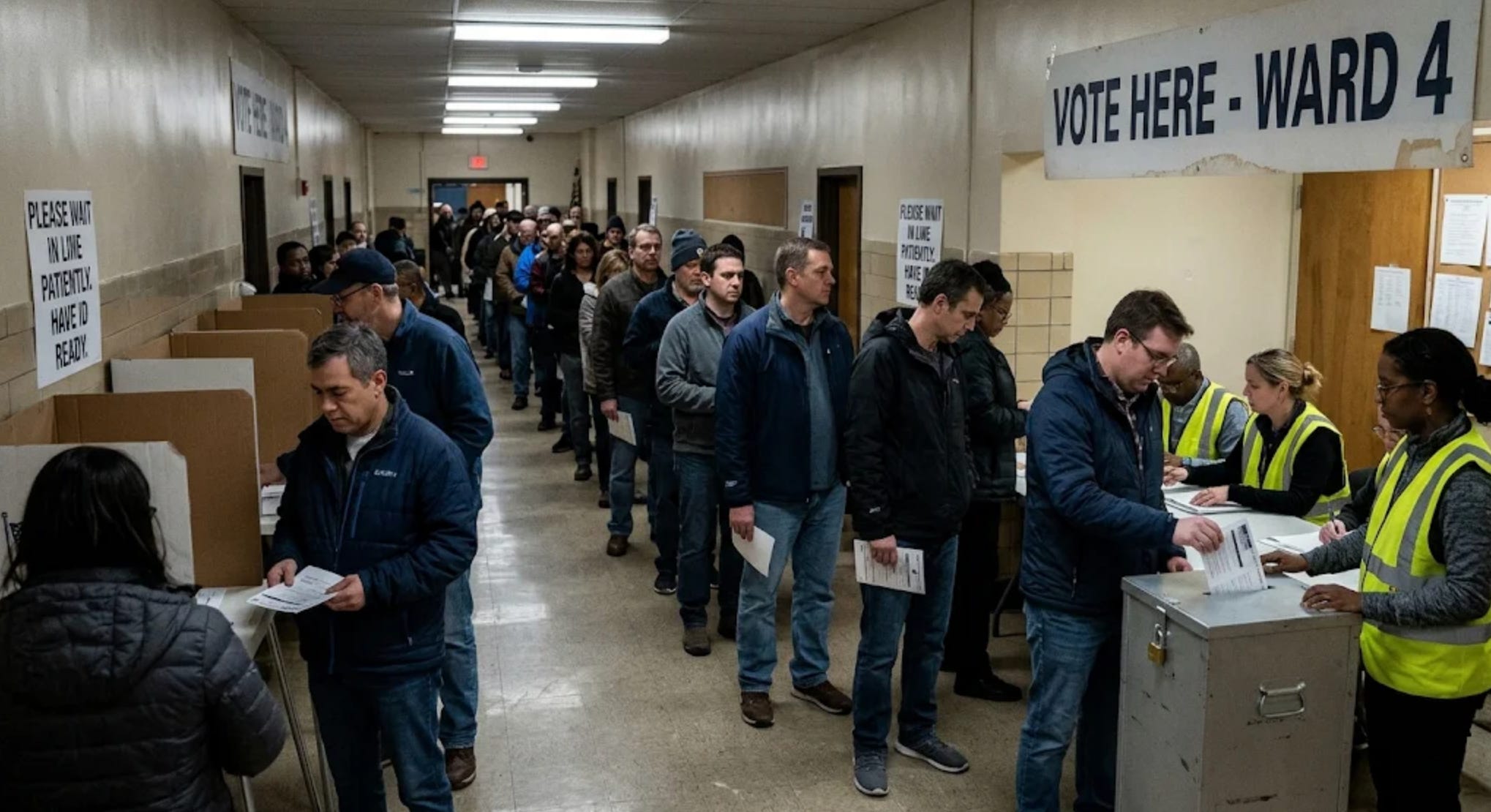
Voting is a humiliation ritual. We line up, we act like we have a voice and a choice, but the outcome was shaped long before anybody filled in their bubbles. And every time we vote for something better, we get betrayed, and then we show up and do it all over again.
It’s been four days since the midterms. Back in August 2021, I wrote this, and I haven’t changed my mind:
“It doesn’t matter if you voted for Bush or Kerry or Obama or Romney or Clinton or Biden or McCain or whoever the fuck.... What’s it going to take to get you to understand that you don’t have a say? Here’s how it works: Promises are made. You buy into the promises. The vote is rigged. Promises are broken. New promises are made. And your gullible ass buys it all over again.”
So, let’s look at the record and see how well that holds up....
What is a humiliation ritual, anyway?
A humiliation ritual is something the people in power try to make you take part in, in public and over and over, that shows you and everyone watching how little power you have, while you’re told the whole time that it’s proof of how much power you have. You don’t just watch the humiliation ritual happen to you. You help perform the humiliation ritual, and that’s what makes you complicit.
And that’s why it’s humiliating. Look at what voting asks of you. You stand in line, you put on the sticker, and you argue with your friends and neighbors about which side is better. Inevitably, the promises get broken, and then you’re left with two choices. You can admit you were played, in front of the same people you argued with, or you can keep defending the people who played you. Either way, you’re the one who ends up looking foolish, not them. And the next time you complain, somebody tells you, “Well, you voted for this,” so your own vote gets held up as proof that you agreed to be betrayed and humiliated.
The researchers at Human Dignity and Humiliation Studies define humiliation as “when you are put down, held down, rendered helpless, and feel hurt.” Being put down is bad enough. Being made to help do it to yourself, and then having your help used as your consent, is what turns it into humiliation.
The former British diplomat Carne Ross wrote about elections this way in 2024, and he said the voter gets the worst of it: “But the greatest humiliation is reserved not for the politician but for the voter who is obliged to vote for them.”
The ritual part is the point. Nobody drags you to the polls. You go because you were taught that this is what a good citizen does, and the people who benefit from the system have every reason to make sure you keep believing it.
Does what you want change what Congress does?
In 2014, two political scientists, Martin Gilens of Princeton and Benjamin Page of Northwestern, published a study called “Testing Theories of American Politics.” They took 1,779 policy questions that national surveys asked Americans between 1981 and 2002, and they checked whether each policy was “actually adopted, within four years after the question was asked.”
What they found is the reason a lot of us stopped believing in this. Once they held the preferences of wealthy Americans and organized interest groups steady, they noted that “it makes very little difference what the general public thinks.” In their words, “The probability of policy change is nearly the same (around 0.3) whether a tiny minority or a large majority of average citizens favor a proposed policy change.” So no matter what bill comes before Congress, and no matter whether people support it or not, that bill has about the same 30 percent chance of becoming policy.
Now look at whose opinion changes the odds. When the wealthy opposed a change, it was adopted about 18 percent of the time. When they strongly favored it, it was adopted about 45 percent of the time. Strong opposition from interest groups dropped the odds to 16 percent, and strong support raised them to 47. Gilens and Page summed it up themselves in the paper: “average citizens and mass-based interest groups have little or no independent influence.” (Mass-based interest groups are the big membership organizations that are supposed to speak for ordinary people.)
Other political scientists pushed back. Peter Enns showed in 2015 that what middle-income and wealthy Americans want lines up almost perfectly most of the time, so ordinary people often get what they want anyway. A 2017 study by Branham, Soroka, and Wlezien found “the middle class, the rich, and the poor almost always agree on policies,” and when they disagree, “the rich win only slightly more often.” Gilens and Page say themselves that “ordinary citizens often win the policies they want,” but only when those policies “happen also to be preferred by the economically elite citizens who wield the actual influence.” Which, if you think about it, is my point. Ordinary citizens only get what they want when the “people who matter” want it too.
Is there really a uniparty?
The congressional voting record shows that no matter who is elected, we seem to have a uniparty that bows down to the corporate structures in our society. They fight loudly on camera, and then the bills with the most money behind them sail through with both parties voting yes.
And the money can go either way. In his 2013 book Extortion, Peter Schweizer, then a fellow at the Hoover Institution, wrote that politicians in some parts of the country call them “milker bills,” bills “intended to ‘milk’ companies and individuals to pass or stop legislation that will benefit or hurt them.” In his words, “these bills are designed not to make good law, but rather to raise money,” and “politicians often don’t want these bills to pass because if they do, the opportunity for future extortion is removed.”
The best kind, he wrote, is the “double-milker,” which is “designed to play two deep-pocketed industries against one another, setting off a lucrative arms race.” His example is the 2011 antipiracy bills, which set Hollywood against Silicon Valley. He reports that Silicon Valley gave “a paltry $1.7 million” to Obama’s reelection campaign in the first half of 2011, and that once the bills were moving, “the tech industry brought in more than $10 million over the second half of 2011.”
Then there’s the “tollbooth,” where “the Speaker of the House or a powerful chairman will erect one on the eve of an important vote,” and “if the tribute offered by those who want the bill to pass is not large enough, the vote will be delayed.” Schweizer’s example is the Wireless Tax Fairness Act of 2011. It had 232 cosponsors from both parties and sailed through committee in July, and then it waited for months for Speaker John Boehner to schedule a vote. Boehner finally scheduled it for November 1, and on the day before the vote, his campaign collected “thirty-three checks from wireless industry executives, totaling almost $40,000.” So both sides pay, and the bill goes to whoever pays the most.
Look at the roll calls. In 1999, the Gramm-Leach-Bliley Act repealed the part of Glass-Steagall that had kept commercial banks and investment banks apart since the Depression. It passed the Senate 90 to 8 and the House 362 to 57, and a Democratic president signed what a Republican Congress sent him. In 2008, the bank bailout passed the Senate 74 to 25 and the House 263 to 171. And watch what happens with the defense bill every year. The first House vote on the 2025 defense authorization split almost straight down party lines, 217 to 199. The final version passed 281 to 140, and the Senate passed it 85 to 14. The next year it went from 231 to 196 on the first House vote to 312 to 112 on the final one.
Meanwhile, the money keeps pouring in. Federal lobbying hit a record $4.4 billion in 2024, according to OpenSecrets, led by the National Association of Realtors, the U.S. Chamber of Commerce, and the drug industry.
Pew Research, using a measure built from members’ actual votes, found in 2022 that “Democrats and Republicans are farther apart ideologically today than at any time in the past 50 years.” But even FiveThirtyEight, arguing against the uniparty idea in 2024, admitted that most “recently passed legislation in the House” was “the product of bipartisan majorities.” So, on paper, the parties are farther apart than they’ve been in fifty years, and most notably, what passes still passes with both of them voting yes.
Who decides who you get to vote for?
In 2016, a group of Bernie Sanders donors sued the Democratic National Committee, saying the primary had been tilted toward Hillary Clinton. At a hearing in April 2017, the DNC’s lawyer, Bruce Spiva, argued the party had no legal obligation to run a fair primary at all. “We could have voluntarily decided that, ‘Look, we’re gonna go into back rooms like they used to and smoke cigars and pick the candidate that way.’ That’s not the way it was done. But they could have. And that would have also been their right.” (He also argued the primary was “fair,” for the record.) The case was thrown out on standing, and the judge wrote that the voters’ “redress is through the ballot box.” No court ever ruled on whether the party favored Clinton.
That same year, Tim Canova, a law professor at Nova Southeastern University, ran against Debbie Wasserman Schultz in the Democratic primary for Florida’s 23rd District while she was chairing the DNC. He got in after the DNC cut the Sanders campaign off from its voter database weeks before the Iowa caucus, and he says he raised about $3.8 million, nearly all of it in small online donations, without a penny of PAC or corporate money. Bernie Sanders endorsed him in May 2016, and that July, Wasserman Schultz resigned as DNC chair after WikiLeaks published the committee’s emails. Canova told Badlands Media’s Why We Vote that by the end of the race, his campaign was knocking on 12,000 doors a week and its field numbers had him “running away with the race.” The official count gave Wasserman Schultz 56.8 percent and Canova 43.2.
Here’s what happened next, in his telling and in the court record. The day before the primary, he says, the local NBC station’s website showed Wasserman Schultz up by 15 or 16 points with about 70 percent of precincts reporting, before a single ballot had been counted, and the page came down after his campaign took screenshots.
Analysts who had studied the Sanders and Clinton primaries told him the cumulative vote tallies in his race bent at an angle he says is “consistent with engineering the source code to count each Wasserman Schultz vote by more than one and each Canova vote by less than one.” (That’s the same idea as Fraction Magic, which comes up below. We’ll get to that in a minute.)
He refused to concede and sued to inspect the paper ballots. He says a South Florida developer close to Wasserman Schultz, Stephen Bittel, met with him while the lawsuit was going and told him he could be the next attorney general of Florida if he’d concede and endorse her and Hillary Clinton. He didn’t.
In September 2017, while his lawsuit was still pending, Broward County’s supervisor of elections, Brenda Snipes, signed off on destroying the ballots, and federal law says ballots from a federal election have to be kept for 22 months. In May 2018, Judge Raag Singhal ruled that she had destroyed them illegally. Her office answered that it had kept scanned copies that were “an exact duplicate of the paper ballots.” Nobody was ever charged. When Governor Rick Scott suspended Snipes in November 2018, his order said she had “improperly authorized the destruction of ballots cast in the 2016 Primary Election, in violation of state and federal law.” Two months later, Governor Ron DeSantis voided the suspension and accepted her resignation instead.
In 2018, Canova ran again as an independent and got 4.9 percent. He says that number came out about the same in every party, every demographic group, and every precinct, and that the computer scientist David Bader, now at the New Jersey Institute of Technology, told him the odds of that were like winning the lottery every day for a year. When Canova couldn’t get Republicans to do anything about the destroyed ballots, he says his election lawyer, Len Collins, a Republican who had once worked for Marco Rubio, made some calls and came back with this: “Tim, you’re not going to get any help from the Republicans. Not in Tallahassee and not in Broward County.” Why not? They have “the same lobbyists, the same media consultants, the same financial backers.” And here’s how Canova put the rules of the game: “You’re not supposed to do what I did when you lose. You’re really supposed to be more gracious. Endorse the person who rigged against you. Maybe there’ll be a position for you in the party if you do that.”
The debates are the same story. The Commission on Presidential Debates was founded in 1987 by the chairmen of the Democratic and Republican National Committees, and since 2000, a candidate has needed 15 percent in national polls to get on that stage. And while the two big parties get on every state’s ballot automatically, an independent candidate in 2016 would have needed more than 860,000 signatures to do the same.
Look at what happened to the people who tried. In 1992, Ross Perot made it onto the debate stage as an independent, and he won 18.9 percent of the popular vote. In 1996, the commission left him off the stage, saying he didn’t have a realistic chance to win, and he got 8.4 percent that time.
In 2000, the year the 15 percent rule started, Ralph Nader couldn’t even get into the audience. He had a ticket to the first debate at the University of Massachusetts in Boston, and a commission representative and three police officers stopped him at the door. He sued, and in 2002, on the eve of trial, the commission agreed to apologize and pay him an undisclosed sum.
In 2016, the Libertarian Gary Johnson was on the ballot in all 50 states and averaging about 10 percent in four-way national polls that August, which wasn’t enough. He and the Green Party’s Jill Stein sued the commission under antitrust law and the First Amendment, and a federal judge threw the case out. Johnson finished with almost 4.5 million votes, the best result the Libertarian Party has ever had, and he never set foot on that stage.
UPCOMING WORKSHOPS:
Shift Your Timeline - Live on Zoom
Dates:
Sunday, November 29, 10AM to 7PM Eastern
Sunday, December 20, 10AM to 7PM Eastern
In this one-day live workshop, the audio guides your body into deep stillness while your mind stays fully awake and alert, opening you into a state of expanded consciousness. Then, we move into a state outside of time. While you’re in that state, you focus on embodying the life you want instead of the one you’re currently headed toward. The idea is that choosing it clearly, in that state, makes it more likely to happen.
Starfire Signals - Live on Zoom
Dates:
Monday, November 30, 8 PM to 10 PM Eastern
Tuesday, December 8, 10 AM to Noon Eastern
Monday, December 28, 8 PM to 10 PM Eastern
In this bimonthly live class, the audio settles your body into deep rest while keeping your mind fully alert, opening the door to expanded consciousness. In that relaxed state, you practice noticing what your intuition is telling you, and writing it down before you second-guess it. Over time, that makes it easier to trust what you’re sensing and helps you to tap into your own guidance on command.
Starfire Spark - Live on Zoom
Dates:
Thursday, November 19, 8:30 PM to 10:30 PM Eastern
Thursday, December 17, 8:30 PM to 10:30 PM Eastern
In this monthly live class, you listen to special audio that helps your body relax deeply while your mind is still wide awake, tapping into expanded consciousness. Then, still on the call, you make something — a timed sprint where you write, play, or create without stopping to judge it. Some meetings, you’ll share one small piece of what you made with the group. Most meetings, you leave with something new that didn’t exist before class started.
Why do we keep reelecting people we can’t stand?
Gallup’s October 2026 poll put Congress’s approval rating at 14 percent. And yet between 2016 and 2022, somewhere between 91 and 97 percent of House members who ran for reelection won.
Money explains a lot of that. In 2024, according to an OpenSecrets analysis, the top 1 percent of donors supplied half of all federal campaign money. In 2014, the biggest spender won 94 percent of House races and 82 percent of Senate races.
The economist Steven Levitt found in 1994 that campaign spending “has an extremely small impact on election outcomes, regardless of who does the spending,” and a Rutgers political scientist told FiveThirtyEight that winning tends to attract money more than money causes winning. Kamala Harris raised more than $1 billion in 2024 and lost.
Larry Sharpe, who ran for governor of New York as a Libertarian in 2018 and 2022, told me about the grift that comes after the race when he was on my podcast in July 2023. “Let’s say you raise 13 million dollars. You spend 10. There’s three million left in your account,” he said. “As long as it’s political, it’s fine. So you take your political money, give it to a PAC. And the PAC hires you as executive director and pays you a salary. You just get money back. You bought yourself a job.” He called the crowded presidential fields “legal money laundering operations” and said the people who lose end up one of three ways: in the winner’s cabinet, with a TV, radio, or podcast show, or working for “some form of political action committee or think tank.”
He gave examples. He said he’d told everybody that Lee Zeldin, the Republican who lost to Kathy Hochul in 2022, would be running a PAC within three months. Zeldin launched the Leadership America Needs PAC on March 1, 2023, less than four months after the election, and in January 2025, the Senate confirmed him as Trump’s EPA administrator. Larry used Nikki Haley as his example of the think tank route. She suspended her presidential campaign in March 2024, and on April 15, 2024, she joined the Hudson Institute, a think tank in Washington, in a newly created chair. Her campaign’s FEC reports show it refunded $5.9 million to donors and still had $1.7 million in the bank at the end of 2024, and I haven’t seen any record that her campaign money went to Hudson.
The rules leave room for the same move through a charity. The Federal Election Commission says gifts to charity aren’t personal use “as long as neither the candidate nor any member of the candidate’s family receives compensation from the charitable organization before it has expended the entire amount donated.” The rule only covers the time before the charity spends the gift. Last month in Florida, Alicia Farrant, who lost her race for Orange County school board chair, gave $19,000 in leftover campaign money to Impact Nations, a Christian charity she runs with her husband, Jonathan Farrant. He’s its president, and its tax records show he drew a salary of $33,000 in 2024. She has never reported income from it, and the gift is legal. In September and October 2024, the Harris campaign paid $500,000, in two payments of $250,000, to the National Action Network, the nonprofit Al Sharpton founded, according to FEC records. Sharpton interviewed Harris on MSNBC on October 20. Fox News reported from the group’s tax filings that in 2021 it paid Sharpton a base salary of $348,174 and a bonus of $278,503.
What happens to the promises?
They get broken, by both parties, every time. George H. W. Bush told the 1988 Republican convention, “Read my lips: No new taxes!” In 1990, he signed a budget deal that raised them. Barack Obama promised to close Guantanamo, and 41 prisoners were still there the day he left office. He also told Americans, “If you like your health care plan, you can keep it,” and in November 2013, after people started losing plans they liked, he went on NBC and said, “I am sorry that they are finding themselves in this situation based on assurances they got from me.” Donald Trump promised Mexico would pay for the wall, and it didn’t. On the campaign trail, he promised over and over to end the war in Ukraine in 24 hours, and at the end of October, more than four and a half years into that war, the fighting was still going on. Joe Biden said he wouldn’t pardon his son Hunter, and then on December 1, 2024, he did.
I wrote about this in 2023, and it still stands: “After all, admitting we’ve been duped is painful. When we’ve invested hope in a politician who has let us down over and over, it feels better to buy into the fresh promises being made during the new campaign cycle.”
Is the outcome rigged?
My personal opinion: yes. Most of the rigging happens before a single vote is cast, in who gets on the ballot, who gets on the debate stage, who gets funded, and what reaches the floor. Twice in the last twenty-six years, in 2000 and 2016, the candidate who got fewer votes became president. And 2020 is where a lot of people’s trust finally broke, so let’s go through what’s documented, what’s claimed, and what the record says.
First, let’s look at 2000. In Palm Beach County, Florida, the supervisor of elections, Theresa LePore, designed a “butterfly ballot,” with the candidates’ names on facing pages and the punch holes down the middle. She said she made it that way “to make the type bigger, so the ballot would be easier for the county’s seniors to read.” Pat Buchanan got 3,407 votes there, and even Buchanan said that “most of those are probably not my vote.” Six political scientists later estimated in the American Political Science Review that the ballot “caused more than 2,000 Democratic voters to vote by mistake for Reform candidate Pat Buchanan, a number larger than George W. Bush’s certified margin of victory in Florida,” which was 537 votes. Then came the “hanging chads,” those infamous little paper squares that voters hadn’t punched all the way out of their punch-card ballots, and weeks of election workers holding ballots up to the light to decide whether a dimple in the punch-card paper counted as a vote. On December 12, 2000, the U.S. Supreme Court stopped the recount in Bush v. Gore, five to four. Almost a year later, a group of news organizations had every disputed ballot reviewed. Bush stayed ahead under the limited recounts Gore had asked for and under the recount the Florida Supreme Court had ordered, but “Gore edged ahead under all the scenarios for counting all undervotes and overvotes statewide,” by 42 to 171 votes. Congress answered the mess with the Help America Vote Act in 2002, nearly $4 billion that put touchscreen voting machines into polling places all over the country. (You’ll see what the computer scientists did to those machines below.) LePore lost her next election, in 2004, to Arthur Anderson, an education professor at Florida Atlantic University.
Of the 64 lawsuits Trump and his supporters filed in the six battleground states, 20 were dismissed before any hearing on the merits, and 14 were withdrawn by Trump’s own side, according to “Lost, Not Stolen,” a 2022 report by a group of conservative judges, senators, and lawyers. That’s 34 of 64 that never got a hearing on the evidence. The Pennsylvania Supreme Court extended the state’s mail ballot deadline by three days, and about 10,000 ballots arrived in those three days. Justice Clarence Thomas later wrote that “The Constitution gives to each state legislature authority to determine the ‘Manner’ of federal elections,” and that the court had changed the rules anyway. In Wisconsin, the state supreme court ruled in 2022 that the drop boxes used in 2020 “are illegal under Wisconsin statutes,” and then a newly composed court reversed that in 2024, 4 to 3 both times.
Facebook’s Mark Zuckerberg and Priscilla Chan gave $350 million to the Center for Tech and Civic Life, which handed out grants to nearly 2,500 election offices. Twenty-eight states had banned or restricted private money in elections by April 2024.
In February 2021, TIME published a story by Molly Ball describing “a well-funded cabal of powerful people, ranging across industries and ideologies, working together behind the scenes to influence perceptions, change rules and laws, steer media coverage and control the flow of information.” And in October 2020, 51 former intelligence officials signed a letter saying Hunter Biden’s laptop had “all the classic earmarks of a Russian information operation.”
In August 2024, Zuckerberg wrote to Congress that Facebook had demoted the story after FBI warnings, that “It’s since been made clear that the reporting was not Russian disinformation,” and that “we shouldn’t have demoted the story.”
And the laptop didn’t start with the New York Post’s story on October 14, 2020. On September 25, a YouTube channel called Lude Media, part of the network around the exiled Chinese billionaire Miles Guo (Guo Wengui), broadcast claims that hard drives full of material on Hunter Biden had been sent to the Justice Department and Nancy Pelosi, and Twitter accounts tied to Guo’s G News shared it with the line “Big money and sex scandal!”
Three days later, Steve Bannon, who was working with Guo at the time, told the Dutch news program Nieuwsuur, “We have the hard drive. I have the hard drive of Hunter Biden.” On October 13, Lude Media said on a livestream that the Post would publish the next day, and it did. So Guo’s network was talking about what was on that laptop weeks before anyone else. The earliest G News release of the files themselves that I’ve found so far is October 24, when it published what it said were sex videos of Hunter Biden, ten days after the Post.
The warnings about the voting machines came long before 2020, from the people who know them best. On August 5, 2016, Politico Magazine ran a cover story by Ben Wofford called “How to Hack an Election in 7 Minutes.” Princeton professor Andrew Appel bought a Sequoia AVC Advantage voting machine online for $82. His graduate student, Alex Halderman, picked its lock in seven seconds, and Appel pulled out its four ROM chips, which “weren’t soldered into the circuit board,” and swapped in firmware that could quietly change the vote count.
When Diebold’s code leaked in 2003, researchers found its encryption key right there in the code, “essentially in plain view.” Virginia’s WINVote machines ran on Wi-Fi, and their encryption key was “abcde.” Sequoia, which Dominion later bought, “once threatened Princeton’s Felten and Appel with legal action if they attempted to examine one of their models.” Jeremy Epstein, the computer scientist who got the WINVote machines banned in Virginia, said, “If these machines and elections weren’t hacked, it was only because no one tried.”
A spokesperson for the voting machine company ES&S answered that “You would be hard pressed to find an example of our voting systems ever being hacked in a real election environment,” and Wofford added that “it’s never been proven that an election was deliberately hacked.”
Alex Halderman kept at it. As an expert for the plaintiffs in a long-running lawsuit over Georgia’s voting system, he found nine flaws in Dominion’s ImageCast X, a touchscreen machine used in more than a dozen states, and in June 2022 the federal Cybersecurity and Infrastructure Security Agency, CISA, put out an advisory on them. CISA’s executive director, Brandon Wales, said, “We have no evidence that these vulnerabilities have been exploited.”
Then there’s Fraction Magic, which I mentioned earlier. In May 2016, Bev Harris of Black Box Voting and the programmer Bennie Smith published a series saying “a fractional vote feature is embedded in each GEMS application which can be used to invisibly, yet radically, alter election outcomes by pre-setting desired vote percentages to redistribute votes.”
GEMS is the central vote-counting software that has been sold under five company names: Global Election Systems, Diebold, Premier, Dominion, and Election Systems & Software. Harris wrote that it counted about 25 percent of all the votes in the United States, statewide in Alaska, Connecticut, Georgia, Mississippi, New Hampshire, Utah, and Vermont and in counties in 20 other states.
Instead of each vote counting as 1, she wrote, “the vote is allowed to be 1/2, or 1+7/8, or any other value that is not a whole number,” so “regardless of what the real votes are, candidates can receive a set percentage of votes.” The decimals stay hidden “unless specifically instructed to reveal decimals,” and “all evidence that fractional values ever existed can be removed instantly even from the underlying database.” She wrote that the tampering “is not visible to election observers, even if they are standing in the room and watching the computer,” that it is “unlikely to be detected by auditing or canvass procedures,” and that it “can be applied across large jurisdictions in less than 60 seconds.”
The instructions to count votes as decimals are written into the GEMS source code more than once, she wrote, “thus, this feature cannot have been created by accident.” And according to programmer notes, there’s a weighted-race feature that assigns each voter a weight in a table GEMS doesn’t show: “Our testing shows that one vote can be counted 25 times, another only one one-thousandth of a time, effectively converting some votes to zero.”
Smith, a Memphis application developer, got into this in August 2014, when a group of candidates told him their elections had been stolen. He disagreed with them and offered to look into how the system works. To show what the feature can do, Harris took a copy of Alaska’s 2004 statewide vote database, which the Alaska Democratic Party got through a court order in 2006, and moved Kerry from 34.73 percent to 55.24 percent, changing more than 200,000 votes in a few seconds. The series demonstrates this as proof of concept. In real election data, Smith found small discrepancies in Shelby County, Tennessee, Morrow County, Ohio, and DeKalb County, Georgia, which he “believed could be round-off errors,” including one Shelby County race that came up one vote short out of 144,609. The University of Iowa computer scientist Douglas Jones said in November 2016 that he was less alarmed by the fractional setting than by the fact “that it is silent,” called that “a very strange design decision,” and added, “I can’t say that I have any findings.”
Ron Watkins, who posted as “CodeMonkeyZ” and ran the 8kun message board, was one of the loudest voices on Dominion. In a sworn declaration filed in the Michigan lawsuit, he wrote that Dominion’s software “may both enable voter fraud by unethical officials out to undermine the will of the people, and honest officials making simple, nearly untraceable, mistakes,” and in November 2020 he shared a video of a Georgia election worker, saying the worker would “manipulate the data, then palm the USB.” In August 2021, he posted leaked election files from Mesa County, Colorado on Telegram, including a spreadsheet of equipment passwords.
HBO’s 2021 series Q: Into the Storm ended with him saying, “It was basically what I was doing anonymously before, but never as Q,” and then, right after, “I promise. Because I am not Q, and I never was.” The director, Cullen Hoback, concluded he was Q anyway. In February 2022, two teams of researchers told the New York Times their software matched the early Q posts to the writing of Paul Furber, a South African developer, and the later ones to Watkins, after Q moved to the 8chan board his father, Jim, owned. Both men denied it. “I am not Q,” Watkins told the Times. He ran for Congress in Arizona in 2022 and finished last of seven with 3.5 percent of the vote.
The most-watched footage came from State Farm Arena in Atlanta, where Fulton County counted its absentee ballots. On December 3, 2020, Giuliani’s team played a clip of it for a Georgia Senate committee. In Mollie Hemingway’s account in The Federalist, observers and reporters left “en masse” in the 10 o’clock hour after a supervisor said counting would stop for the night, and then “a small remnant of about four workers began pulling trunks containing thousands of ballots from underneath a table” and ran them through the machines starting around 10:35 p.m. A state monitor didn’t arrive until 11:52 p.m. Earlier that day, Fulton had blamed a delay in the count on what was reported as a burst pipe, and the secretary of state’s chief investigator, Frances Watson, later said in an affidavit that it was an overflowing urinal.
Georgia officials tell it differently. Gabriel Sterling, who managed Georgia’s voting system, said the Gwinnett County worker in Watkins’s video was a 20-year-old contractor who was “transferring a report on batches” from the election management system “to a county computer so we could read it,” and that the young man had gotten death threats and a noose. On the State Farm Arena footage from Atlanta, the secretary of state’s chief investigator, Frances Watson, said in a sworn affidavit that investigators found “no mystery ballots that were brought in from an unknown location and hidden under tables,” and that the containers were “boxes sealed and openly placed there by workers who briefly, incorrectly thought they were done counting for the night.” State officials walked WSB-TV through the footage frame by frame: the table had nothing under it when it was brought in at 8:22 a.m., and around 10 p.m., with monitors and reporters still watching, workers packed opened but uncounted ballots into the containers, sealed them, and put them under the table. Minutes later, Fulton’s election director called and told the arena to keep counting, after the secretary of state’s office said counting shouldn’t stop that early. Two of the workers in that footage, Ruby Freeman and her daughter, Shaye Moss, sued Rudy Giuliani for saying they had snuck in ballots in suitcases. He conceded in court documents that he had falsely accused them, and in December 2023, a jury awarded them $148 million.
Watkins’s sworn declaration only says what Dominion “may” or “could” allow, not that it happened. The federal judge in that Michigan case found “nothing but speculation and conjecture that votes for President Trump were destroyed, discarded or switched.” Antrim County, Michigan, the county that was supposed to prove the machines flipped votes, hand-counted every presidential ballot, and the net difference was 12 votes out of 15,718. Georgia hand-counted all five million ballots. The Republican-led Arizona Senate’s own review in Maricopa County found Biden with 99 more votes than the official count. A Republican-led committee in the Michigan Senate “found no evidence of widespread or systematic fraud.” An AP review found fewer than 475 possible fraud cases across all six battleground states. Attorney General Bill Barr said the Justice Department had “not seen fraud on a scale that could have effected a different outcome.” Fox News paid Dominion $787.5 million to settle. The “Lost, Not Stolen” authors concluded the cases “failed because of a lack of evidence and not because of erroneous rulings or unfair judges.” (One detail critics point to - the official statement calling 2020 “the most secure in American history” was co-signed by a council that included voting machine companies.)
The lawyer who brought that Michigan case was Sidney Powell, who had promised to “release the Kraken.” Dominion sued her for $1.3 billion in January 2021. Her lawyers’ answer, that March, was that “no reasonable person would conclude that the statements were truly statements of fact,” and that “any press conference originating from the Republican National Committee is political to its core.” That August, Judge Linda Parker sanctioned Powell and the other lawyers on the Michigan case, calling it “a historic and profound abuse of the judicial process,” and the Sixth Circuit upheld most of the sanctions in 2023. In October 2023, Powell pleaded guilty in Georgia to six misdemeanor counts of conspiracy to commit intentional interference with the performance of election duties, in the case that included the copying of election data in Coffee County, and she got six years of probation, a $6,000 fine, and an apology letter to write. Dominion settled with her and with Rudy Giuliani in September 2025 without saying for how much. A few weeks later, Dominion itself was sold to a company run by Scott Leiendecker, a former Republican election director in St. Louis, and renamed Liberty Vote, and it promised to push “hand-marked paper ballots.” Dominion had also sued MyPillow’s Mike Lindell for $1.3 billion, and in June 2026, Liberty Vote ended that suit with a confidential settlement, which Lindell called a “big relief.” As of October 2025, the company was still suing Patrick Byrne, the former Overstock CEO who backed Arizona’s Senate review, and his lawyer said Byrne was “looking forward to a trial.” (Byrne says that case is still open. I’ll come back to him in a minute.)
Then there are the dead voters. Some of them were real. In Pennsylvania, Bruce Bartman of Delaware County pleaded guilty in April 2021 to voting for Trump in the name of his mother, who had died more than ten years earlier. “I listened to too much propaganda and made a stupid mistake,” he said. In Nevada, Donald Kirk Hartle, whose wife’s ballot Republicans held up as proof that dead people were voting, was charged with casting that ballot himself. In Michigan, the state’s auditor general found in 2022 that 1,616 counted ballots came from people who were dead on Election Day. Most of those were absentee ballots the voters had mailed in legally before they died, and Michigan is supposed to reject those. (Clerks did reject 3,469 others.) The audit also found 20 people recorded as voting in 2020 who had died before absentee voting even started, and many of them shared a name with another voter.
The big numbers are a different story. One Trump analyst said 10,315 dead people voted in Georgia, and when the secretary of state’s office investigated, it found four. The Nevada Republican Party said 1,506 ballots were cast in the names of dead people, and the secretary of state’s office found 10 of those names listed as deceased by the state’s vital records office. In Arizona, the Senate’s review said 282 ballots were cast in the names of dead people, and Attorney General Mark Brnovich, a Republican, found one. The others turned out to be alive and still registered.
And the places with more votes than voters? Trump posted that in Detroit there were “FAR MORE VOTES THAN PEOPLE.” Detroit has about 670,000 residents, and the city counted 250,138 ballots. A sworn affidavit by Russell Ramsland, used in the Michigan lawsuits, listed 19 precincts where the votes topped 100 percent of the estimated voters, and those precincts turned out to be in Minnesota. One of them, Monticello P-2, which the affidavit put at 138 percent, had 4,202 registered voters and 3,776 votes for president. In Pennsylvania, 17 Republican state lawmakers said in December 2020 that the state had 202,377 more votes than voters, and the Department of State answered that its count of voters came from voting histories some counties hadn’t finished uploading yet.
What’s real is smaller and messier. In Detroit, about 70 percent of the absentee counting boards didn’t balance, which means the number of ballots didn’t match the number of names in the poll books, and the estimates of how many votes that covered run from about 300 to 400. That’s what Monica Palmer and William Hartmann, the two Republicans on the Wayne County canvass board, pointed to when they first refused to certify the county’s results. Palmer said, “I do not have good faith that the poll books were complete and accurate.” And in October 2020, Judicial Watch reported that 352 counties in 29 states had 1.8 million more registered voters than eligible voting-age citizens. Those would be names on the rolls, not ballots cast. But rolls that full of people who shouldn’t be on them are exactly why so many people stopped trusting the count.
Then there’s 2000 Mules. In May 2022, Dinesh D’Souza released a documentary built on research by the group True the Vote and its analyst Gregg Phillips. In the film, they say they bought “10 trillion” cellphone location signals and looked for people who went to ten or more ballot drop boxes and made five or more visits to the nonprofit groups they believed were running the operation, and they called those people mules. In Atlanta alone, they say they found 242 mules who “went to an average of 24 dropboxes,” and they say they collected “4 million minutes of surveillance video” of drop boxes around the country. Informants in the film say the going rate was “generally $10 a ballot in the Georgia runoff.” Counting five ballots per drop box visit, the film says the mules in Arizona, Georgia, Michigan, Pennsylvania, and Wisconsin cast enough illegal ballots to give Trump the win “with 279 electoral votes to Biden’s 259.”
In 2021, before the film came out, the director of the Georgia Bureau of Investigation, Vic Reynolds, wrote that True the Vote’s cellphone data, “while curious, does not rise to the level of probable cause that a crime has been committed.” Bill Barr told the January 6 committee he was “unimpressed,” that “If you take 2 million cell phones and figure out where they are physically in a big city like Atlanta,” you’ll find hundreds of them “have passed by and spend time in the vicinity of these boxes,” and that “The premise that if you go by a box, five boxes or whatever it was, you know that that’s a mule is just indefensible.” When Georgia’s State Election Board subpoenaed True the Vote for its evidence, the group told a judge in 2024 that it didn’t know who its own anonymous source was and didn’t have any documents about illegal ballot collection. One man shown in the film, Mark Andrews of Gwinnett County, had already been cleared by the GBI, which found he was legally dropping off ballots for his own family. He sued. In May 2024, the film’s distributor, Salem Media, pulled the film and the book and apologized “for the hurt the inclusion of Mr. Andrews’ image in the movie, book, and promotional materials” caused him, and in August of this year, D’Souza settled with him on the eve of trial.
So, here’s how I read this. Molly Ball wrote that the people she was describing “were not rigging the election; they were fortifying it.” You can call it fortifying. You can call it rigging. Either way, a small, well-funded group decided the rules and the information you saw before you ever got to vote, and the public found out afterward. That’s the humiliation part of the ritual.
Channeled messages posts go out to paid subscribers every day. Tarot, shufflemancy, numerology, runes, and meditation applied to the specific energies of the day, delivered directly to your inbox.
Why does the losing side always end up finding the rigging?
The most surprising thing I found while researching this piece is how the case against the voting machines changes sides every time the White House does, and how little the arguments change when it does.
In 2003, the CEO of Diebold, one of the biggest voting machine companies, who was also a top fundraiser for George W. Bush, wrote that he was “committed to helping Ohio deliver its electoral votes to the president.” Through the Bush years, the loudest alarms about the machines came from the left, including Bev Harris, whose work became the 2006 HBO film Hacking Democracy.
In April 2019, with Trump in the White House, the Guardian ran a two-part series on the private companies that run American elections. It reported that “a small network of companies” held “near-monopolies on election services,” and that the vendors had “long histories of errors that affected elections, of obstructing politicians and the public from seeking information, of corruption, suspect foreign influence, false statements of security and business dishonesty.” Senator Ron Wyden, an Oregon Democrat, said the voting machine lobby “literally thinks they are just above the law, they are accountable to nobody.” Representative Jamie Raskin, a Maryland Democrat, introduced a bill to keep states from hiring election vendors owned or influenced by foreign nationals, after Maryland found out its main election vendor had been bought in 2015 by a company with ties to a Russian oligarch. The FBI found no evidence of tampering, and Raskin said, “To say that they don’t have any evidence of any wrongdoing is not to say that nothing untoward happened,” and “It’s simply to say that we don’t have the evidence of it.” The Guardian said his bill could affect two companies: Dominion, and Scytl, a company based in Spain that handles election-night reporting.
After 2020, those two companies were at the center of the case from the other side. In July 2023, David and Erin Clements wrote, in a piece the Gateway Pundit republished, that “the real powerhouse in election night reporting comes from a foreign owned, Spain-based company, called Scytl,” and they pointed back to the Guardian series: “Those concerns, however, evaporated after Joe Biden was installed.” They also wrote that “votes are being fractionalized and automated through an algorithm,” which is close to what Bev Harris published as Fraction Magic in 2016, aimed at the other party.
Raskin turns up on both sides of it. In March 2022, he and Representative Carolyn Maloney opened an investigation into the audit of Otero County, New Mexico, that the Clementses had worked on. They asked the audit’s contractor, EchoMail, for its records and said they were looking into whether its door-to-door canvass was “intimidating voters in violation of federal law.” Clements calls the letter a cease-and-desist order and says it pushed the county to back away from the audit. In 2019, Raskin wanted foreign-owned vendors like ByteGrid, Maryland’s contractor, kept out of American elections. In 2022, he investigated a citizen audit of Otero County’s 2020 results, which the county had counted on Dominion machines.
These companies keep crossing paths, too. Smartmatic, founded by three Venezuelan engineers, bought Sequoia in March 2005. After a review by the federal Committee on Foreign Investment in the United States, Smartmatic sold it to Sequoia’s American managers in 2007, and in June 2010, Dominion bought Sequoia’s assets. That’s the same Sequoia we saw in the Politico article whose AVC Advantage machine Appel bought for $82. In August 2017, Smartmatic’s own CEO, Antonio Mugica, said of Venezuela’s constituent assembly election, “We know, without any doubt, that the turnout of the recent election for a National Constituent Assembly was manipulated,” by at least a million votes. And on July 16 of this year, Trump declassified a CIA summary of intelligence from 2004 to 2020 on “Venezuela’s Electronic Voting Manipulation Capabilities.” It says Venezuelan officials had “sustained interest and likely some capability in manipulating electronic voting systems, including Smartmatic technology,” and it cites “intelligence that Smartmatic directors held credentials from Venezuela intelligence services.” The same note says the CIA’s baseline assessment found mass electronic fraud didn’t happen in Venezuela’s 2012 election, and it doesn’t say Venezuela changed a vote in the United States.
Patrick Byrne says it did. He told Sarah Westall this week that he has 15 whistleblowers from Venezuela, engineers he says helped build the system, that teams of federal agents interviewed them from May through July, and that the CIA note is “this tepid thing” next to what they told the agents. He says the lead engineer told General Michael Flynn, “we’ve been manipulating elections for 20 years in 72 nations,” that the motherboards are made “60 miles outside of Beijing,” and that “the center of gravity of Dominion is over in Serbia.”
Those are Byrne’s claims, and I haven’t found the 15 accounts he describes in public. I did find one account like them. The Election Crime Bureau has posted what it calls sworn testimony from an unnamed former national coordinator of voting machines for Venezuela’s National Electoral Council, who says a tool called SAES Data Utility “can allow you to inject votes without people knowing you did so.” And in December 2025, Hugo Carvajal, Venezuela’s former intelligence chief, wrote to Trump that Smartmatic was created as an electoral tool for Venezuela’s government. He offered no evidence in the letter, and he pleaded guilty in 2025 to narcoterrorism and drug trafficking charges in the United States. Smartmatic says its technology was used in only one place in the 2020 election: Los Angeles County.
On October 27, a federal judge in Florida, Tom Barber, ruled for Byrne in the libel suit Eric Coomer, Dominion’s former director of product strategy and security, brought over Byrne’s film The Deep Rig. Byrne posted that “the judge read our evidence and realized I was correct.” The ruling turned on actual malice. Coomer had to show by “clear and convincing evidence” that Byrne doubted what he was saying. Byrne testified that he “believed Oltmann’s story and remains highly confident” it was true, meaning the Colorado podcaster Joe Oltmann’s account of hearing Coomer on a conference call. The judge wrote that Byrne’s “lack of skepticism, failure to investigate, and disregard for government reports” were “equally consistent with negligence and a belief that there was essentially a coverup going on,” and that under a lower standard of proof, “it is likely that Byrne’s motion for summary judgment would have been denied.”
Byrne also said something I didn’t expect: “Just didn’t even vote for Trump in the first two elections. I’m not a Trumplicant.” And when Tucker Carlson had David Clements on his show, Carlson told his audience Clements “didn’t even vote for Trump in 2016” and “thought of himself as a never Trumper.” It seems interesting and important that two of the best-known voices against the 2020 machines started out outside of Trump’s camp.
The 2024 version runs the other way. After Trump won, a volunteer group called the Election Truth Alliance and a number of writers here on Substack started pointing to the same kinds of anomalies Republicans pointed to in 2020. Peter Ehrlich, who writes Into the Details and said he expected to find “fraud from both sides,” borrowed the “Russian tail,” a pattern researchers use to spot ballot stuffing in Russian elections, and found what he called “an asymptote heading towards 60% of the vote” for Trump, while calling one of his charts “far from conclusive.”
Kait Justice, who writes Downwind of Truth, notes that the following three things are really one story. In texts NPR obtained and authenticated, Elon Musk wrote to Ashley St. Clair on October 6, 2024, that “tomorrow we unleash the anomaly in the matrix,” then “’Lasers’ from space,” and “I have over 10 thousand lasers in space right now.” On January 19, 2025, Trump told a rally that Musk “knows those computers better than anybody, all those computers, those vote-counting computers, and we ended up winning Pennsylvania like in a landslide.” And on June 5, 2025, in the middle of their public fight, Musk posted, “Without me, Trump would have lost the election.” Musk’s lawyer, Alex Spiro, says the lasers are the links between Starlink satellites, and Musk has threatened to sue the documentary that aired the texts.
Justice also looks back at Coffee County, Georgia, where in January 2021 a team paid by Sidney Powell’s nonprofit copied the county’s Dominion system while the security cameras rolled. She reads it as “getting the blueprints so the next attempt could account for what went wrong.” Jeff Lenberg, a computer expert and Clements’s client, reads the same Dominion system as proof of how exposed it is, and says Curling v. Raffensperger is “the case where CISA had to admit the tabulators had massive vulnerabilities.” That’s the case where Halderman found the nine flaws. So the same machines were evidence for Trump’s side in 2020 and for Harris’s side in 2024.
Michael Sellers, who writes that he admires SMART Elections, the group behind the recount suit in Rockland County, New York, checked its best example himself. The five machines that recorded zero votes for Harris are in Monsey and Kaser, Orthodox and Hasidic communities that vote as a bloc, and he found that “the same machine that recorded 0 votes for Kamala Harris in 2024 also recorded 0 votes for Joe Biden in 2020.” In December 2025, state judge Rachel Tanguay dismissed the suit for lack of standing, and the group answered, “We want to emphasize the case was not dismissed on its merits.” Trump’s supporters said the same thing about the 2020 cases.
And 2020 hasn’t gone away. In December 2025, Fulton County’s attorney, Ann Brumbaugh, told Georgia’s State Election Board, “We do not dispute that the tapes were not signed. It was a violation of the rule.” About 130 tabulator tapes covering some 315,000 early votes never got the poll worker signatures the rules require. The board voted 3-0 to send it to the attorney general. Janelle King, a Republican on the board, said, “At best, this is sloppy and lazy,” and “At worst, it could be egregious, and it could have affected an election.” Georgia’s secretary of state, Brad Raffensperger, a Republican, called it a clerical error that doesn’t erase valid votes. Damien Duncan wrote in February that Fulton “counted 315,000 ineligible ballots” and that “it has been ascertained there were numerous counterfeit ballots, and all of these were directed to Joe Biden.” The board’s record describes unsigned tapes, which breaks a rule about paperwork. The record on counterfeit ballots goes the other way. In 2021, a poll monitor, Suzie Voyles, swore she had seen “pristine” absentee ballots, and after the secretary of state’s office and the Georgia Bureau of Investigation looked, their review found “no trace of counterfeit ballots,” according to the Georgia Recorder. In 2024, state investigators couldn’t substantiate the pristine-ballot claim either, though they partly confirmed that some batches were scanned twice during the recount Trump requested. On January 28, the FBI searched Fulton County’s election hub and loaded the 2020 ballots onto trucks, with Director of National Intelligence Tulsi Gabbard on site. Trump had said the week before that “people will soon be prosecuted for what they did.” I haven’t found any charges from it. In July, a federal judge, William Ray II, quashed the Justice Department’s grand jury subpoena for the names and home addresses of everyone who worked Fulton’s 2020 election. He called it “staggering,” agreed with the county that it was an “arbitrary fishing expedition,” and said the five-year statute of limitations on most 2020 election crimes had likely run out.
On March 7, 2025, at a White House event with FIFA’s president, Gianni Infantino, Trump was talking about how sad he was during his first term to think he wouldn’t be president for the 2026 World Cup, and he said, “And then what happened is they rigged the election, and I became president. So, that was a good thing.” He didn’t say which election he meant, but the timeline points to 2020. If he had won that one, his second term would have ended in January 2025, and he wouldn’t be president for the World Cup. Read that way, he was repeating his claim that 2020 was rigged against him, and the loss is what put him in office in 2026. Ehrlich opens his whole analysis with the same quote and reads it the other way, asking, “in whose favor was it rigged?”
Then there are writers who add it up the other way. David Pearl, who calls fraud claims a myth, cites Justin Levitt of Loyola Law School, who found 31 credible cases of voter impersonation out of more than a billion ballots cast from 2000 to 2014, and the Heritage Foundation’s own database, which turned up 36 fraud cases in Arizona across 25 years and 42.6 million ballots. Roger Westermeyer compares the rate to the odds of being struck by lightning. And Christopher Scheuer argues that the counts have been rigged since the 1960s, mostly to keep Republicans competitive, and that “’16, ‘20 & ‘24, the Trump Elections, were corrupted.”
When I line all of this up, the pattern is the same every time. The side that loses goes looking at the machines, the side that wins defends them, and every few years they trade places. The companies stayed the same through all of it, and so did the secret source code and the private ownership. Wyden’s complaint in 2019 and the Clementses’ in 2023 are about the same two companies. And when you read what each side asks for, it comes out close: paper ballots people can count by hand, code people outside the companies can inspect, and audits the vendors don’t control. In that 2019 Guardian series, the election law expert Candice Hoke said, “We need independent auditing and forensics assessments and other kinds of IT assessments that are not controlled by the vendors.” The company that bought Dominion now says it’ll push hand-marked paper ballots. That’s common ground, and almost comically, the people who share that common ground coming from either side are always so sure that the opposition side is lying.
But don’t your votes ever decide anything?
Sometimes. In 2017, a Virginia state house race came down to a tie decided by a single ballot, and control of the chamber was settled by pulling a name out of a ceramic bowl. In 2024, a California House seat was decided by 187 votes. In 2022, 59 percent of voters in Kansas, a state Trump won by 15 points, defeated a constitutional amendment their own Republican-led legislature put on the ballot. That same year, California voters rejected both sports betting measures on their ballot, after DraftKings and FanDuel on one side and Native American tribes on the other spent about $450 million on the fight.
I think that’s telling. The closer an issue is to you, the less the money can control it. The farther away it gets, up to the presidential race and the bills with the lobbyists behind them, the more the ritual takes over.
Personally, I don’t vote. I said it in 2024: “I don’t vote anyway. I don’t consent to be governed.” That’s my choice, and yours is your own. But I wrote this a few days after Butler in 2024, and I think it’s the most important thing I can tell you: “Convincing you to vote for your own slave-master is the biggest, sickest racket there is. Nobody is coming to save us. Free your mind instead.”
How do you walk out of a humiliation ritual?
The way out starts with noticing you’re in one. A humiliation ritual needs your help, over and over, and it needs you to believe your help is proof of your power. Every time you catch yourself defending someone who broke a promise to you, because the alternative is admitting you got played in front of the people you argued with, you’re bolstering the humiliation ritual from inside of it. You can admit you got played. It costs you a little pride once. But when you take your lumps and stop reinforcing the cycle, you stop paying for it every two years.
Then look at how the feeds work on you, because the people who built them have told us how they are constructed and what they are attempting to accomplish. Sean Parker, Facebook’s first president, told Axios in 2017 that the site was built to “give you a little dopamine hit every once in a while,” that “It’s a social validation feedback loop,” and that “You’re exploiting a vulnerability in human psychology.” He said he and Mark Zuckerberg understood that “consciously, and we did it anyway.” The same year, Chamath Palihapitiya, a former Facebook vice president, told a Stanford audience, “The short-term, dopamine-driven feedback loops we’ve created are destroying how society works.” In 2020, the Wall Street Journal reported that a Facebook researcher had found in 2016 that “64% of all extremist group joins are due to our recommendation tools,” and that a 2018 internal slide said, “Our algorithms exploit the human brain’s attraction to divisiveness.” The algorithmic silo you’re in was built to corral you, and manufactured division is what keeps you stuck in it, banging your drum.
Look at what that does to the way you see people. In 2019, the research group More in Common asked Americans what they believed and what they thought the other side believed. It found that “Democrats and Republicans imagine almost twice as many of their political opponents as reality hold views they consider ‘extreme,’” and that “the more news people consumed, the larger their Perception Gap.” So the people who follow politics most closely have the most distorted picture of the other side. The neighbor you’ve written off likely agrees with you on more than your feed will ever show you.
We used to know how to find common ground with people we disagreed with. I think we lost it to three things: algorithmic silos that sort us by what makes us angry, dopamine loops that keep us scrolling inside them, and weaponized nuance, where one true detail gets blown up to stand for a whole side, or “it’s complicated” gets used to shut down a fair question.
The Overton window works on you the same way. The idea comes from Joseph Overton, a vice president at the Mackinac Center, a free-market think tank in Michigan. His colleagues say he described a narrow band of ideas politicians can pass into law, and that “Joe never called it the Overton Window. He called it the Window of political possibilities.” In his version, the window moves when the public’s ideas move, and politicians follow. So when everything you read tells you an idea is unthinkable one year and settled the next, ask yourself who moved the bar, why they moved it, and what they get from moving you. The controversy surrounding the voting machines shows how this works. In 2019, the Guardian treated worry about the vendors as a national security story. By 2021, the same worry from the other side was being called the Big Lie. In 2024, it came back from the first side. The vendors and the worry both remained the same. What changed was the objective and who the spin job helped.
Here’s what I’d do….
Pick one person who votes differently than you do and ask what they want for their family and their town. Then listen without planning your comeback.
Read the other side in its own words, not in your side’s summary of it. Form your own opinion based on your own critical thinking skills by taking in information that comes from places where you wouldn’t ordinarily look for it. You will form more well-rounded opinions this way. There is something of an art to this. But it is also a skill we used to cultivate on purpose which, in the age of dopamine loops and algorithmic siloing, has gone sorely missed.
Turn off the recommendation feeds where you can and switch to the chronological ones. When a headline makes you angry and you feel the pull to keep scrolling, that’s the dopamine loop Parker described. You can put the phone down.
Look up how your own representatives voted on the final version of the big money bills, like the defense authorization and anything to do with banks. The House Clerk and the Senate post every roll call, and the final vote is the one that tells you who they work for.
Look up who funds them. OpenSecrets lists every member of Congress’s top donors and the industries behind them. Compare that list to how they voted.
Watch the pendulum. Every cycle, the side that lost gets told the other side is the end of the world, and it swings back. In my words from 2024: “Observe the hypnotic swing of the pendulum - it never ends well because it never comes to rest in the middle.” When you notice that swing is always in motion because every push brings another shove, you lessen the frequency at which you get thrown by it.
Put your time and attention where you can see results. Your attention is the thing they’re really after. Remember that where you place it is yours to decide.
Do you think voting still changes anything, or is this the ritual I think it is? Tell me what you think in the comments.
Personal readings, custom natal astrology charts, 1:1 coaching sessions with Demi, and more can be found here:
yip. I like the GC quote about voting "he who counts the vote counts".
Key important point about voting is the legal meaning of registration which is giving partial control and ownership to who you register something with.
registering YOUR vote with the State means you have given partial control and ownership of YOUR vote to the State and they can put it where they want.
Voting for govt over and over and expecting a different result = insanity .
Adding to my previous point: This perspective misses a fundamental truth about human existence: we are separate individuals, but we also share a powerful collective component that impacts us all. We are part of a singularity--an interconnected whole--and what happens in our governance inevitably shapes our shared reality, whether we choose to participate or not.
Because we are bound to this collective reality, we have a profound, inescapable responsibility toward it. Walking away and refusing to vote doesn't free you from the whole; it just leaves a vacuum for the most distorted voices to fill. True conscious evolution isn't about isolating yourself from the singularity in defeat. It’s about staying present, recognizing the positive shifts and high-integrity leadership when they emerge, and taking active responsibility to elevate the collective from the bottom up.