

🌟 The Oracle Chamber at Hal Saflieni was built 5,000 years ago to produce a specific effect in the human brain. It still works.
On acoustic archaeology, the 110 Hz resonance, and what the builders of megalithic structures understood about consciousness that we have been slowly rediscovering for fifty years.

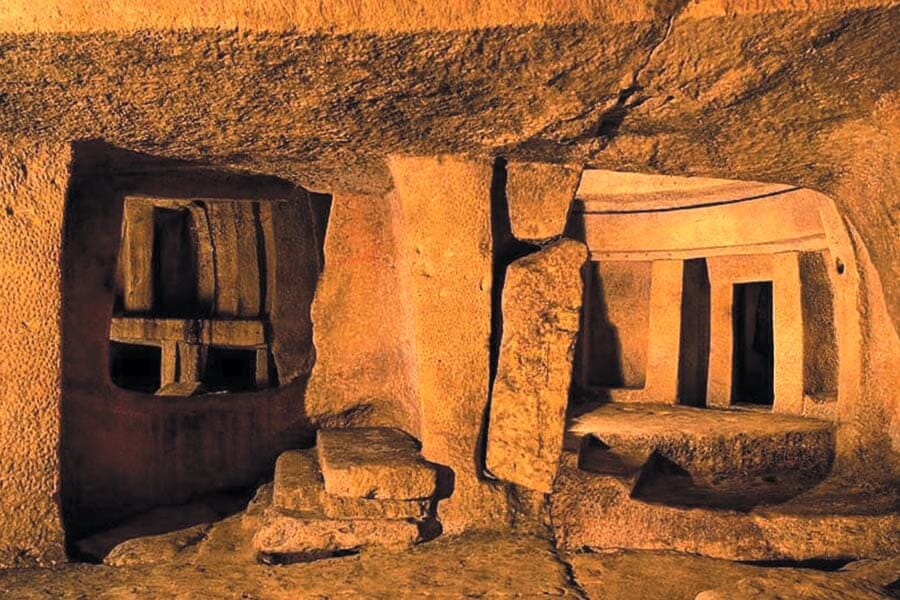
The thing I keep coming back to, doing this work as long as I have, is that the traditions that maintained genuine knowledge did not survive by accident. They survived because they were encoding something real. The Hal Saflieni Hypogeum is one of the clearest physical demonstrations of that I know of.
It is a subterranean temple complex in Malta, carved from solid limestone approximately 5,000 years ago. UNESCO calls it a World Heritage Site. Archaeologists mostly describe it as a burial site. What it actually is, based on the acoustic measurements researchers from the University of Salford have been publishing since the late 1990s, is a precisely engineered resonance chamber. The Oracle Chamber specifically, a small room on the third level with a curved ceiling that took considerable technical skill to carve, produces a resonance at approximately 110 Hz when a baritone voice speaks inside it. The resonance does not decay the way sound in a small room normally decays. It extends through the surrounding stone.
Neuroscientist Ian Cook and colleagues at UCLA measured what 110 Hz does to the brain in 2008. The results showed altered right-hemisphere activity, specifically in areas associated with mood regulation, social bonding, and the kinds of experiences people have historically called spiritual. That is not coincidence. Acoustic archaeologist Aaron Watson has documented the same deliberate engineering, the same 110 Hz target, at Stonehenge, at the long barrows of Orkney, at the Chavin de Huantar in Peru. These cultures have no known documented contact with each other; however, they shared the understanding that specific acoustic frequencies produce specific effects in human consciousness, and they built permanent stone structures to deliver those frequencies at scale.
The tradition is not in some vague category of ancient wisdom. It is a specific applied technology that people maintained and transmitted across thousands of years because it worked. It produced real, measurable, repeatable results in human perception. What we call intuition, what practitioners in this lineage call expanded perception, has a measurable frequency signature. The Oracle Chamber was built to induce it on purpose.
That lineage of expanded consciousness is what a reading draws on. Not a gift, not a talent. A practice with documented roots in the physical architecture of the oldest intact temple complex on the planet.
🌟 Clarity Readings are open through Thursday at midnight. $50, regular price $144. 🌟
Further Reading
Cook, I. A., Pajot, S. K., & Leuchter, A. F. (2008). Ancient architectural acoustic resonance patterns and regional brain activity. Time and Mind, 1(1), 95-104.
Devereux, P. (2001). Stone Age Soundtracks: The Acoustic Archaeology of Ancient Sites. Vega.
Reznikoff, I., & Dauvois, M. (1988). La dimension sonore des grottes ornees. Bulletin de la Societe Prehistorique Francaise, 85(8), 238-246.
Scarre, C., & Lawson, G. (Eds.). (2006). Archaeoacoustics: The Archaeology of Sound. Oxbow Books.
Till, R. (2010). Songs of the stones: An investigation into the acoustic culture of Stonehenge. Journal of the International Association for the Study of Popular Music, 1(2), 1-18.
Watson, A., & Keating, D. (1999). Architecture and sound: An acoustic analysis of megalithic monuments in prehistoric Britain. Antiquity, 73(280), 325-336.
I have believed for a long time we sell our ancestors short just because the technology and knowledge they had of many vital subjects was different, but in some ways actually superior to our fantastic progress in our present showy and complex ways. This is especially true in the areas of real healing, sound and vibration and the mostly hidden and unacknowledged abilities of the human mind and spirit. The difference is one of essence and not form. We have become masters of form, but the essence is sadly often something quite different and inferior to what I believe has been possible at other times and places.
I wonder why it’s 110hz. It’s interesting that the mid register male voice does this. What does this mean for tropes on the difference between male and female consciousness? —One of many things needing reexamination in light of what we are learning about things long forgotten in the prehistory of our culture. What ended Sumer? Was it the collapse into philosophical materialism that repeatedly announced the decay of monument building cultures at various times and places (Egypt, Gobeckli Tepe, and even Rome)?