


Three questions, full divination suite, direct read on the energies surrounding each one. The Clarity Reading: Limited spots at $50. Regular price $144.
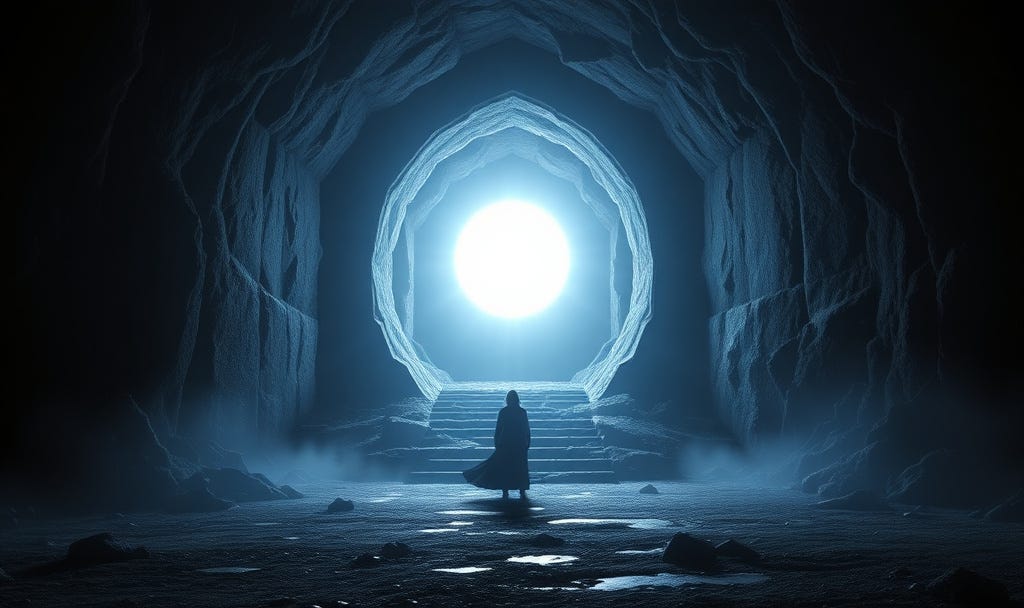
In October 2021, I published what I had received in the first channeled message I ever got. Do not go toward the light when you die. The light recycles you. It brings your soul back down to earth, puts you in a new body, and wipes your memory so you consent to doing it all over again without knowing you already have, probably many, many times.
I was told to go to the void instead.
I knew when I published it that a lot of you were going to recognize it immediately. Some of you had already known this for years and just hadn’t had language for it. What I didn’t fully anticipate was how many of you were going to process this for months and then come back and ask where you could find the research.
Well, here it is.
Because when you actually go looking, nearly every serious ancient tradition that addressed what happens after death was saying this before we were born. The same instructions, across different languages, different centuries, different vocabularies, addressing the exact same thing. And the cultures that were most explicit about it are also the ones that got systematically destroyed. I’ve thought about this for years. The pattern is much too consistent to be random.
Channeled messages posts go out to paid subscribers every day. Tarot, shufflemancy, numerology, runes, and meditation applied to the specific energies of the day, delivered directly to your inbox.
Let’s start with what was there before the light got installed.
Siberian shamanism is the oldest documented spiritual tradition we have on record. The soul moves through the void between worlds after death. Not toward brightness but through darkness, through the between-space, through what precedes.
Australian Aboriginal dreaming traditions describe the transition through relationship with land and ancestors. They talk about the spirit world accessed through the ground, through ritual space, through the dark.
African animist traditions express the same.
The light as a destination, as the thing you orient toward and walk into, is absent across all of them.
Think about what that means. These are the oldest traditions we have. The ones that predate the institutions that would later decide what you were supposed to believe about death. And every single one of them sends you toward the dark, toward the void, toward the between-space, into the liminal. That consistency should be telling you something.
Celtic initiatory rites were conducted inside earthmounds in complete darkness. On purpose. The candidate went in and sat while the ritual proceeded, and the darkness was the entire process. You had to go through the dark before emergence was even possible.
The variance in instruction, the instruction to walk into a white light as a sort of afterlife navigation, appears at a specific point in history. And what I find extremely interesting is that the traditions that emerged at that exact same historical moment, the ones that got sealed into clay jars and buried in Egypt and not rediscovered until 1945, contain explicit warnings about exactly those particular instructions.
The Nag Hammadi texts.
The Apocryphon of John, one of the central texts from the library, describes what happens after death in language that is going to feel familiar to you if you’ve been here since 2021. The material world, in the Gnostic framework, was created by a lesser, flawed entity called the Demiurge. The Demiurge’s administrators are called Archons. Their function is to maintain the cycle of incarnation and keep souls ignorant of what they actually are.
After death, the soul tries to ascend, and at each level an Archon is waiting. A soul that knows its own nature, that understands itself as something larger than the material life it just lived, can pass. A soul completely absorbed in the material world, with no awareness of itself as a fragment of something greater, gets turned back.
Here’s the part that stopped me cold when I found it.
The Hypostasis of the Archons, another Nag Hammadi text, states that the Archons are blind to the true light. They have no access to it. What they CAN produce is a copy. A counterfeit, specifically engineered to attract a soul looking for its way home.
So the warmth, the familiar faces, the overwhelming love, the feeling that you’ve finally arrived somewhere safe and true… the Gnostic texts identify all of these as coming from a manufactured environment, an environment that was made specifically to generate your consent to return.
The trap is beautiful by design. Something that looked like a trap would announce itself as being one. So, instead, it looks and feels like home.
And here is the part that I think about more than anything else in this entire article: It requires you to say yes. You are a sovereign being. The system has to get your consent. Which means it has to find the thing you have not let go of yet, whatever that might be. And whatever it is, it will be specific to you. It will not be some generic warmth. It will come in the form of the person you cannot imagine leaving, the one you are still worried about, the child you are not ready to stop protecting, the relationship that ended before it was finished, the conversation you never got to have…. Whatever you are still gripping onto right now as you’re reading this, that is what will be waiting. And it will be wearing the face you love most, and asking you to stay.
Plato documented the mechanics of this in the Myth of Er, from the Republic, written in the 4th century BCE. In ancient Greek, “myth” means account, narrative, story… not necessarily fiction. Er was a soldier who died in battle and came back to life nine days later. He watched what happened to souls after death.
What he saw was a system.
After choosing their next lives, every soul was marched to the River Lethe, the River of Forgetfulness, and required to drink from it before going back into a body. Required. The text says those saved by wisdom drank less and forgot less. But every soul drank.
Pay attention to that part: The forgetfulness is administered. There is a river. You are required to drink from it. And this means that whatever you have spent this lifetime almost remembering, whatever has felt like it was right there at the edge of your awareness and then slipped back under, the reason it keeps doing that is not because you are not paying attention. The reason is the river. You drank from it. Before the life you are living right now, you drank from it and forgot, and you have been spending years trying to remember something you were deliberately made to forget.
The Orphic mystery tradition, which predates Plato by centuries, had a protocol for exactly this. Initiates were trained before death to seek the River of Mnemosyne, Memory, instead of Lethe. And then they were buried with gold tablets containing the navigation instructions. Those tablets have been found. They are in museums.
I want you to meditate on what that means for a moment. People made gold tablets. They encoded on them the instructions for navigating the afterlife. And then they put those tablets into the hands of their dead, because they understood that the dead were going to need them and that no other delivery mechanism could be trusted to work. They were trying to send something through to the other side. Across death. They cared enough about what waited on that threshold that they tried to reach across it with a piece of gold.
They were trying to reach you.
The entire Egyptian civilization organized itself around preparation for this same threshold. The Egyptian Book of the Dead, whose actual title means “coming forth by day,” describes the transit through the Duat as something requiring a lifetime of preparation while still in the body. Not a deathbed project. A life’s work.
The central test is the weighing of the heart against the feather of Ma’at. The heart is placed on a scale against a feather that weighs almost nothing. If the heart weighs the same or less, the soul passes. If it is heavier, it does not.
If you book readings whenever a batch opens, the Navigators membership includes one full divination reading every month for $50. Three questions. Full divination suite. Delivered within three business days of submission. No batches. No racing. Regular price for a single reading is $144.
What makes a heart heavy?
Think about your specific answer to that question. The person you have not forgiven, and you know who that is. The relationship that ended wrong, the one that still surfaces at 3am. The thing you said and cannot unsay. The thing you never said and cannot go back and say now. The outcome you are still trying to control from a distance, as if wanting it hard enough will reach through the space between you and the person you’re worried about and make them okay. Every one of those situations has a certain emotional weight to it. Every loop that never closed is weight.
This is why detachment is prescribed in every tradition that addresses liberation. I want to say what detachment actually means, because it gets misread in a way that has caused genuine harm, and I want to address the misunderstanding.
Detachment does not mean loving less. It does not mean not caring what happens. It does not mean cutting yourself off from the people who matter to you or becoming someone who floats above their own life untouched by any of it.
Detachment means releasing outcome. The love stays. The grip goes.
You can love someone with your whole self and still release the need for them to be okay in a specific way. That love weighs what the feather weighs. You can love someone with your whole self and need them to be safe, need to know how it ends, need to go back and make sure, and that need has weight. That is the distinction. Not the love. The grip you have on how it has to play out.
I know that distinction is easy to write and very hard to live. The Egyptians built a civilization around it because it is that difficult and they understood that. You do not get there by deciding to. You get there by releasing things, one at a time, over years, and doing the ongoing work to let go of whatever you have been refusing to let resolve.
The Tibetan Book of the Dead maps this threshold with a precision that still gets me every time I go back to it.
The text was read aloud to the dying and to the dead for up to 49 days after physical death, which is its own remarkable thing. The tradition understood that consciousness does not simply switch off when the body does. And it built an entire practice around that understanding, which says something about how differently they related to death than we do. The Bardo Thodol is basically navigational assistance for a disoriented consciousness at the most consequential threshold it will ever face.
Here is what it says about the light.
At the moment of death, a vast, overwhelming, brilliant clear light arises. The text says this light IS your own awareness. Your own fundamental consciousness, displaying itself without the physical body that was filtering it down to something manageable. If you recognize it as yours and merge with it, you are liberated. Immediately. Done.
Most people do not recognize it. Nothing in embodied experience looks like it. So consciousness turns away from its own nature.
And then come the softer lights.
Over the following days, a sequence of softer, more beautiful, more seductive lights appears. Each one corresponds to a realm of rebirth. Each one is calibrated to the specific attachment patterns of the soul encountering it. Each one is more attractive than the overwhelming clear light precisely because it feels familiar. Like somewhere you can rest. Like home. Like the face of someone you love.
The Bardo Thodol says to go toward the overwhelming clear light. The softer lights lead back into the cycle.
(Now, the Bardo Thodol and my original channeled material are describing two different encounters that both get called “the light.” In the Bardo Thodol, the clear light is your own awareness and liberation; the softer lights are the trap. In what I received, the light is the trap and the void is the exit. What I think is happening is that different traditions are naming different phenomena at the crossing of the same threshold. But in both accounts, the thing that pulls at your attachments, the thing that feels like love and home and the faces you know and the things you left unfinished, takes you back. That is the convergence point that matters.)
Robert Monroe got to the same conclusion from a completely different direction, and I think Monroe matters more than almost anyone else in this conversation for one specific reason.
Monroe was not a mystic. He was not a spiritual teacher, not a monk, not someone who had spent his life inside a tradition that would confirm what he found. He was a Virginia radio executive who started having out-of-body experiences in the 1950s without wanting to, documented them the way a man who built radio stations would document anything, and ended up mapping the infrastructure of the earth system from inside it. He called the harvested energy Loosh, which is emotional energy produced by human experience, particularly the intensity of physical embodiment. The earth, in Monroe’s framework, is a production environment. The reincarnation cycle is what keeps the production running.
He encountered the texts that described the same structure only after he had already found it himself.
That matters. He had no stake in any ancient tradition. He had no reason to arrive at a conclusion that confirmed the Gnostics. He was a radio executive from Virginia having experiences he did not ask for, and he found the same thing. Independent arrival at the same conclusion without influence.
The preparation happens before the moment of death. That is the worst time to figure this out, and every tradition that took this seriously understood that completely. The Orphics encoded the instructions and buried them with the dead because they knew people would not do the preparation ahead of time on their own. The Tibetans had lamas reading the navigation aloud before death and for 49 days after it. The Egyptians spent lifetimes preparing. None of them were improvising at the threshold.
You are still in a body. You are still clear. This means that now is the time to do the work.
Think about what you are still holding onto very tightly. The relationship that did not end the way it should have. The person you owe an apology to. The person you are still waiting for an apology from. The grief you have been managing instead of allowing yourself to feel it, process it, and release it. The outcome you need to know before you can let something go. Those things have weight. And the weight is not abstract. The weight is the mechanism by which the system will produce your consent to return and get stuck here when the moment comes.
It might be better to address them now, while resolution is still possible, while the conversation can still be had, while the thing can still be released inside an actual life rather than at a threshold you have seconds to navigate.
And then there is the harder work, which is learning the difference between loving and holding on.
You are allowed to love the people in your life with everything you have. The love is not the problem. What the tradition is asking you to practice, the thing that took the Egyptians lifetimes to try to teach, is whether you can love someone completely and release the need to know how it ends for them. Whether you can love your child and release the need to see them safe before you leave. Whether you can love your partner and release the need for them to be okay without you. The love stays. What changes is whether that love has a hand closed around any particular outcome.
That distinction is the entire preparation. It is also the hardest thing in this article, and I want to say that plainly.
But you can make the decision now, in a clear state, before you need it. When I die, I am going to the void. Whatever I encounter at that threshold that feels like love and home and the faces of the people I love and the things I left unfinished, I will recognize it for what it is. And I’m going past it.
The Egyptians had an entire civilization built on this. The Orphics had gold tablets. The Tibetans had their lamas. The Gnostics lost everything writing it down and someone buried the texts in the desert anyway so they would survive.
All of them were trying to reach forward through time.
And now, you have this article.
Go to the void.
Further Reading
Assmann, J. (2001). The Search for God in Ancient Egypt. Cornell University Press. Trans. David Lorton.
Atwater, P.M.H. (1994). Beyond the Light: What Isn’t Being Said About the Near Death Experience. Birch Lane Press.
Atwater, P.M.H. (2007). The Big Book of Near-Death Experiences. Hampton Roads Publishing.
Bhaktivedanta Swami Prabhupada (Trans.) (1972). Bhagavad-Gita As It Is. Bhaktivedanta Book Trust.
Brinkley, D. and Perry, P. (1994). Saved by the Light. Villard Books.
Budge, E.A.W. (Ed. and Trans.) (1895). The Book of the Dead: The Papyrus of Ani. British Museum.
Budge, E.A.W. (1904). The Gods of the Egyptians: Studies in Egyptian Mythology. Methuen.
Coleman, G. and Jinpa, T. (Eds.) (2007). The Tibetan Book of the Dead: First Complete Translation. Penguin Classics. Trans. Gyurme Dorje.
Cuevas, B.J. (2003). The Hidden History of the Tibetan Book of the Dead. Oxford University Press.
Eliade, M. (1964). Shamanism: Archaic Techniques of Ecstasy. Bollingen Foundation. Trans. Willard Trask.
Evans-Wentz, W.Y. (Ed.) (1927). The Tibetan Book of the Dead. Oxford University Press. Trans. Lama Kazi Dawa-Samdup.
Fiore, E. (1978). You Have Been Here Before: A Psychologist Looks at Past Lives. Coward, McCann and Geoghegan.
Govinda, L.A. (1960). Foundations of Tibetan Mysticism. Rider.
Greyson, B. (2021). After: A Doctor Explores What Near-Death Experiences Reveal About Life and Beyond. St. Martin’s Essentials.
Hornung, E. (1999). The Ancient Egyptian Books of the Afterlife. Cornell University Press. Trans. David Lorton.
Jung, C.G. (1960). Psychological commentary on The Tibetan Book of the Dead. In W.Y. Evans-Wentz (Ed.), The Tibetan Book of the Dead (3rd ed.). Oxford University Press.
Lash, J.L. (2006). Not in His Image: Gnostic Vision, Sacred Ecology, and the Future of Belief. Chelsea Green Publishing.
Leary, T., Metzner, R. and Alpert, R. (1964). The Psychedelic Experience: A Manual Based on the Tibetan Book of the Dead. University Books.
Meyer, M. (Ed.) (2007). The Nag Hammadi Scriptures: The Revised and Updated Translation. HarperOne.
Monroe, R.A. (1971). Journeys Out of the Body. Doubleday.
Monroe, R.A. (1985). Far Journeys. Doubleday.
Monroe, R.A. (1994). Ultimate Journey. Doubleday.
Moody, R. (1975). Life After Life. Mockingbird Books.
Newton, M. (1994). Journey of Souls: Case Studies of Life Between Lives. Llewellyn Publications.
Ouspensky, P.D. (1949). In Search of the Miraculous: Fragments of an Unknown Teaching. Harcourt, Brace.
Pagels, E. (1979). The Gnostic Gospels. Random House.
Plato (4th century BCE/1992). The Republic. Trans. G.M.A. Grube. Hackett Publishing.
Radhakrishnan, S. (Ed. and Trans.) (1953). The Principal Upanishads. George Allen and Unwin.
Rawlings, M. (1978). Beyond Death’s Door. Thomas Nelson.
Ring, K. (1980). Life at Death: A Scientific Investigation of the Near-Death Experience. Coward, McCann and Geoghegan.
Ring, K. (1984). Heading Toward Omega: In Search of the Meaning of the Near-Death Experience. William Morrow.
Robinson, J.M. (Ed.) (1977). The Nag Hammadi Library in English. Harper and Row.
Sabom, M. (1982). Recollections of Death: A Medical Investigation. Harper and Row.
Sogyal Rinpoche (1992). The Tibetan Book of Living and Dying. HarperOne.
Steiner, R. (1914/1996). The Spiritual Hierarchies and the Physical World: Reality and Illusion. Anthroposophic Press.
Thurman, R.A.F. (Trans.) (1994). The Tibetan Book of the Dead. Bantam Books.
Trungpa, C. and Fremantle, F. (Trans.) (1975). The Tibetan Book of the Dead. Shambhala Publications.
Van Lommel, P. (2010). Consciousness Beyond Life: The Science of the Near-Death Experience. HarperOne.
Weiss, B. (1988). Many Lives, Many Masters. Simon and Schuster.
Yogananda, P. (1946). Autobiography of a Yogi. Philosophical Library.
Zaleski, C. (1987). Otherworld Journeys: Accounts of Near-Death Experience in Medieval and Modern Times. Oxford University Press.
yes the Tibetan book of the dead states that you are reincarnating every moment, that the work to do in the book of enlightening of freedom is here and now.
The heart is weighed and is free from fear and desire.
Ending the egoic attachments only happens with death of the ego( knowing who you are beyond the mind made concept) ,
when you know you are the universe unmanifested( void/emptiness/stillness), the manifested world is all you your heart becomes light as a feather
Nothing real can be threatened.
Nothing unreal exists.
Herein lies the peace of God( Spirit). (ACIM)
In the meantime while we are here let’s make it the place that we would want our children to live in.