


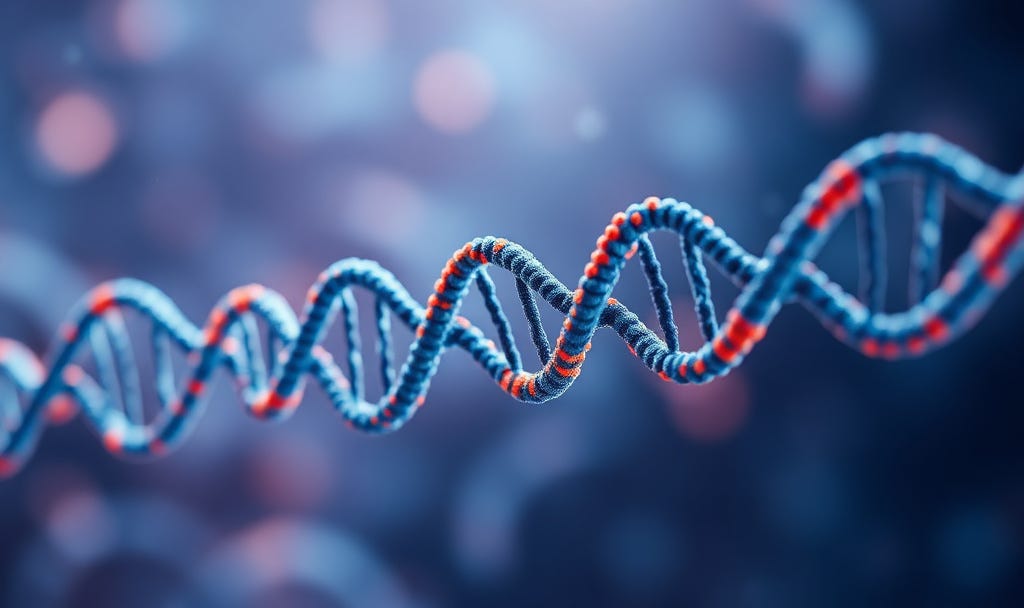
Here is a number worth sitting with. Molecular biologists have mapped the human genome. Of the roughly three billion base pairs in a strand of human DNA, the sequences that code for proteins – the parts that do the identifiable work of constructing the organism – account for approximately three percent of the total. The remaining ninety-seven percent was named, in an act of scientific confidence that is now quietly embarrassing, “junk DNA.” Its function was classified as unknown, which in practice meant: probably not important.
That designation has not aged well.
The junk contains palindromes – sequences that read the same forward and backward, which is a feature of language, not garbage. It contains sequences repeated hundreds of thousands of times with no apparent random variation, which is a feature of signal architecture, not noise. It contains what biophysicist Fritz-Albert Popp at the University of Kaiserslautern spent decades measuring: biophotonic emissions. Coherent light. Produced by the DNA itself, absorbed by the DNA itself, structured in patterns consistent with a communication system operating at speeds and bandwidths the biochemical layer cannot match. Popp called it the organism’s internal light field. He published the work. It replicated. It is not in your textbooks.
Jeremy Narby was a Stanford-trained anthropologist who spent two years in the Peruvian Amazon studying Ashaninca resource use. He kept encountering the same claim from experienced plant medicine practitioners: the detailed pharmacological knowledge of the forest, accumulated across generations with no trial-and-error record, was not discovered. It was transmitted. By the plants themselves, in the specific altered states that the vine produces. He thought this was poetic. Then he started reading molecular biology.
The cosmic serpent appears in the sacred traditions of the ancient Egyptians, the Aboriginal Australians, the Amazonian peoples, the Greeks. Always double. Always twisted. Always described as the provider of attributes and the key of life. The Australian Aboriginal rock paintings he found contained the serpent surrounded by what are unmistakably chromosomes in anaphase – the specific moment of cellular duplication – painted by people who did not have electron microscopes. The Yaminahua shamans of the Amazon describe their knowledge as acquired through “twisted language” – the specific phrase, translated literally, means “language-twisting-twisting.” The DNA filament winds around itself several hundred million times. It is, in both form and function, a doubly double language that wraps around itself.
The altered state, in Narby’s framework, is not a departure from accurate perception. It is a shift into the bandwidth the ninety-seven percent is broadcasting on. The three percent your culture calls the genome is the part that makes proteins. The ninety-seven percent may be doing something the current vocabulary doesn’t have a category for yet – which is not the same as nothing.
What the parapsychology research at the Maimonides Dream Laboratory at Brooklyn’s Maimonides Medical Center found, across hundreds of trials, was that information transfer – telepathy, remote perception, precognition – reliably improved in specific states. Dream states. Hypnagogic states. States where the analytical mind is not operating at full throttle. The three percent of the mind that matches the three percent of the genome that does the legible work. Step out of that bandwidth, and something else becomes available.
A structural description of intuition: a reading accesses the channel the analytical layer cannot reach without stepping aside. A reading operates in that register. I am sitting with your specific field in a state of expanded perception, reading what is broadcasting on the channel the analytical layer cannot reach without stepping aside.
The Career Reading is open through Friday at midnight. Three questions, full divination suite. $50, regular price $144.
Further Reading
Bischof, M. (1995). Biophotonen: Das Licht in unseren Zellen. Zweitausendeins.
Crick, F. (1981). Life Itself: Its Origin and Nature. Simon & Schuster.
Honorton, C. (1977). Psi and internal attention states. In B. B. Wolman (Ed.), Handbook of Parapsychology. Van Nostrand Reinhold.
Narby, J. (1998). The Cosmic Serpent: DNA and the Origins of Knowledge. Tarcher/Putnam.
Popp, F. A. (1992). Some essential questions of biophoton research and probable answers. In F. A. Popp, K. H. Li, & Q. Gu (Eds.), Recent Advances in Biophoton Research and Its Applications. World Scientific.
Popp, F. A., Nagl, W., Li, K. H., Scholz, W., Weingartner, O., & Wolf, R. (1984). Biophoton emission. Cell Biophysics, 6(1), 33-52. [online] Available here: https://link.springer.com/article/10.1007/BF02788579
Townsley, G. (1993). Song paths: The ways and means of Yaminahua shamanic knowledge. L’Homme, 33(126-128), 449-468.
Ullman, M., Krippner, S., & Vaughan, A. (1973). Dream Telepathy: Experiments in Nocturnal Extrasensory Perception. Macmillan.
Hi Demi. Been a while. I see you are still reigning supreme.