

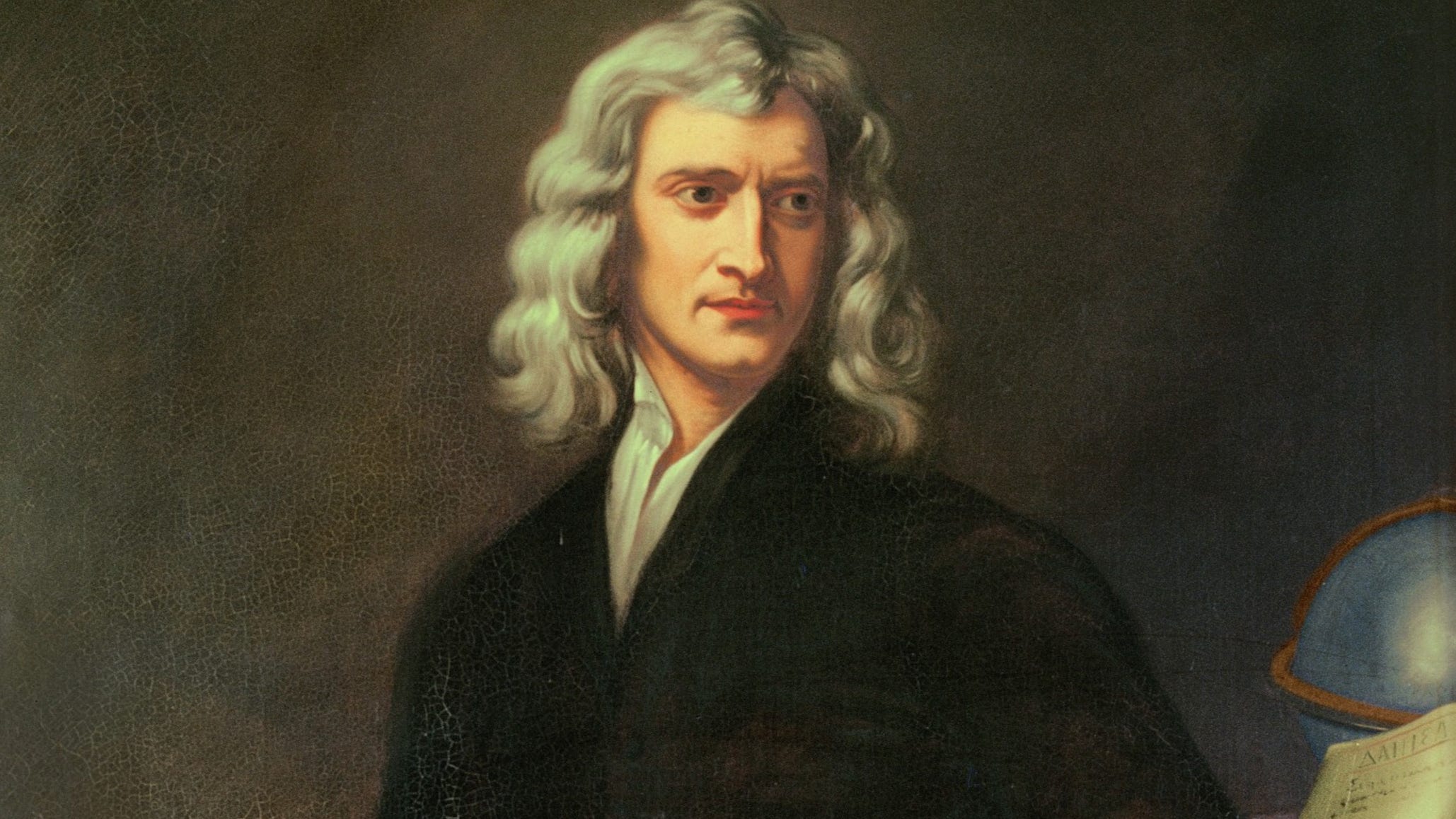
Isaac Newton thought the dates of the ancient world were wrong by about five hundred years, and he was still revising the book that said so when he died in 1727.
Most of us learned about Newton and the apple, and maybe the prism. I’d bet very few of us learned that the last book he worked on was about history, not physics. It’s called The Chronology of Ancient Kingdoms Amended, it came out in 1728, the year after he died, and the note to readers at the front says he “lately revis’d it, and was actually preparing it for the Press at the time of his death.” John Conduitt, who wrote the book’s opening letter to Queen Caroline of Ansbach, called it “the last work of as great a Genius as any Age ever produced.” It runs about 87,000 words.
A book by the most famous scientist in the English language, arguing that the whole timeline of antiquity was off by centuries, and most of us have never heard of it? That gets my attention....
What did Isaac Newton say was wrong with ancient history?
Newton thought the accepted ancient chronology put events too far back in time. So he rebuilt the timeline, and his version came out about five centuries shorter than the conventional one, shorter even than the shortest version anyone else was proposing in his day. His Short Chronicle, the timeline at the front of the book, runs from 1125 BC to 331 BC.
He also treated people most of us file under mythology as real. The centaur Chiron and the Argonauts, the Greek heroes who sailed off after the Golden Fleece, are historical figures in Newton’s book. So he set out to date their voyage, and he used the sky to do it.
How did Newton use the stars to date the Argonauts?
Newton’s method depends on the precession of the equinoxes, which sounds complicated and is pretty simple once you can picture it.
The Earth wobbles very slowly on its axis, like a spinning top that’s starting to lean. Because of that wobble, the point in the sky where the Sun is on the first day of spring creeps backward against the stars, a tiny bit every year. Newton used a rate of one degree every 72 years. Go around the full circle and it takes about 26,000 years. So if an old text tells you where the spring equinox fell among the constellations, you can work out roughly when somebody saw it there.
Newton had exactly that kind of text. The Greek astronomer Hipparchus had reported how Eudoxus, an earlier astronomer, described the sky, and Newton believed that description went back to a sphere, a model of the heavens, that Chiron made for the Argonauts. Hipparchus’s report placed the colures, the imaginary lines astronomers draw through the poles and the equinox and solstice points, among particular stars. Newton took the positions of those same stars from the catalog of John Flamsteed, the Astronomer Royal, measured how far the colures had moved since, and averaged it out to a shift of about 36 and a half degrees. At 72 years a degree, that’s about 2,627 years.
The French summary of his system dated Chiron’s sphere to 939 BC. Newton put the Argonauts’ voyage about 43 or 44 years after the death of King Solomon.
And he was sure of himself. In a draft defending the book against a critic, he wrote: “Let him rectify his mistake, & the Argonautic Expedition will be where I place it.” (Tell us how you really feel, Isaac.)
What did people say when Newton’s dates came out?
This part makes me furious on his behalf. A short abstract of Newton’s system had been going around, and after the Abbé Conti shared it, the abstract was published in France in 1725 without Newton’s permission, with critical observations by a French scholar named Nicolas Fréret attached to it. Newton answered in the Philosophical Transactions, the Royal Society’s journal.
Newton was eighty-two years old in 1725. The book wasn’t finished. He hadn’t agreed to let anybody print even the short version, and now he had to defend a summary he never released, in the Royal Society’s own journal, against objections a scholar in Paris had stapled onto it. I’d have been livid, and judging by the drafts he left behind, so was he. (He was answering a book review of a book nobody had been allowed to read yet. What a damn mess.)
Fréret didn’t let it go, either. His full rebuttal came out in 1758, three decades after Newton was dead. Other critics piled on, too. Edmond Halley, the astronomer the comet is named after, thought the link between Chiron’s sphere and what Eudoxus described was the most questionable part of Newton’s whole system.
UPCOMING WORKSHOPS:
Shift Your Timeline - Live on Zoom
Dates:
Sunday, November 29, 10AM to 7PM Eastern
Sunday, December 20, 10AM to 7PM Eastern
In this one-day live workshop, the audio guides your body into deep stillness while your mind stays fully awake and alert, opening you into a state of expanded consciousness. Then, we move into a state outside of time. While you’re in that state, you focus on embodying the life you want instead of the one you’re currently headed toward. The idea is that choosing it clearly, in that state, makes it more likely to happen.
Starfire Signals - Live on Zoom
Dates:
Monday, November 30, 8 PM to 10 PM Eastern
Tuesday, December 8, 10 AM to Noon Eastern
Monday, December 28, 8 PM to 10 PM Eastern
In this bimonthly live class, the audio settles your body into deep rest while keeping your mind fully alert, opening the door to expanded consciousness. In that relaxed state, you practice noticing what your intuition is telling you, and writing it down before you second-guess it. Over time, that makes it easier to trust what you’re sensing and helps you to tap into your own guidance on command.
Starfire Spark - Live on Zoom
Dates:
Thursday, November 19, 8:30 PM to 10:30 PM Eastern
Thursday, December 17, 8:30 PM to 10:30 PM Eastern
In this monthly live class, you listen to special audio that helps your body relax deeply while your mind is still wide awake, tapping into expanded consciousness. Then, still on the call, you make something — a timed sprint where you write, play, or create without stopping to judge it. Some meetings, you’ll share one small piece of what you made with the group. Most meetings, you leave with something new that didn’t exist before class started.
Was Newton the only one who doubted the timeline?
Nope. Jean Hardouin was a Jesuit priest who became the librarian of the Collège Louis-le-Grand in Paris in 1683, and he went a lot further than Newton did. Hardouin argued that a conspiracy in the 1300s had forged nearly all the literature people thought was older than that. He accepted a small list as genuine, including Homer’s Iliad and Odyssey, Herodotus, Plautus, and parts of Virgil and Horace, and threw out much of the rest, Virgil’s Aeneid among it. He later retracted his views in public, though the book he wrote after 1714 shows he went on holding them. He died in 1729, two years after Newton.
Hardouin’s idea didn’t die with him, either. A mathematician named Anatoly Fomenko, working with colleagues from the mathematics department of Moscow State University, argues in his New Chronology that events we put in ancient Rome, Greece, and Egypt “actually occurred during the Middle Ages, more than a thousand years later.” Wikipedia names Hardouin as an “intellectual progenitor” of that theory, and it also says the New Chronology is “universally rejected by the scientific and historiographical communities.” I’m giving you both ideas so you can weigh them yourself.
You don’t have to buy Hardouin’s forgery conspiracy to notice that the librarian of a famous Paris college and the man who worked out the laws of gravity, alive at the same time, both looked hard at the accepted dates and didn’t believe them.
Newton may well have been wrong about his dates. Halley and Fréret thought so in his own day. My point is that people put together the timeline you were taught, out of sources they cherry picked to follow one narrative while keeping the other narrative undisclosed, and one of the smartest people who ever lived spent the last years of his life arguing with that timeline. Seems like a pretty important argument. Both sides certainly thought so.
So, why didn’t anybody tell you about this book?
Part of the answer is what happened to Newton’s papers after he died. He left no will. His heirs hired Thomas Pellet, a member of the Royal Society, to go through the manuscripts and pick out what could be published. According to the historian James Voelkel, Pellet chose five candidates and labeled the rest “Not fit to be printed.”
The papers went down through the family into the hands of the earls of Portsmouth, who held them for nearly two centuries, and Voelkel writes that “during these years, the manuscripts were seen by almost no one.” (“Almost” being the operative word.)
According to the Newton Project at Oxford, a handful of scholars got in over the years, among them Samuel Horsley in 1777 and David Brewster in the 1800s. In 1872 the fifth Earl of Portsmouth gave the scientific papers to Cambridge, and the committee the university set up spent sixteen years sorting them. Its catalogue finally came out in 1888. Cambridge kept the science. The alchemy went back to the family as “of very little interest in themselves,” and so did the Chronology, the history, and the theology.
Then, on July 13 and 14, 1936, the heir to the Portsmouth estate, Gerard Wallop, who was Viscount Lymington at the time, sold them at Sotheby’s, and the whole collection brought in “just over £9,000.” The historian Sarah Dry, who wrote a whole book on the papers, says he sold them “to meet death duties payable on the estate of his aunt as well as the costs of his impending divorce,” and Physics World tells it the same way. The physicist Freeman Dyson gave a different reason in The New York Review of Books in 2003: he wrote that Lymington was “in need of cash to finance the British Union of Fascists.”
The economist John Maynard Keynes went after the alchemy papers. A scholar named Abraham Yahuda went after the theology, and his collection ended up at what’s now the National Library of Israel, where it only became generally accessible at the end of the 1960s. (Within living memory, in other words.) In those papers is the folio where Newton worked out that a prophetic period “will end A.C. 2060.” Newton was careful about it himself: “This I mention not to assert when the time of the end shall be.”
Keynes read what he’d bought and wrote a talk called “Newton, the Man” for the Royal Society’s celebration of Newton’s three-hundredth birthday. The war pushed the celebration from 1942 to July 1946, Keynes died that April, and his brother Geoffrey read the talk for him. In it, Keynes said: “Newton was not the first of the age of reason. He was the last of the magicians, the last of the Babylonians and Sumerians.” The Chronology belongs to that Newton. It has a whole chapter on the Temple of Solomon, because for Newton the temple’s geometry gave him a timeline of Hebrew history.
My personal opinion, after about seven years of researching the forgetting, which is what I call the way knowledge and memory get lost: you learned about Newton the physicist and never heard about Newton the magician because one man in 1727 decided what was fit to be printed, the family kept the rest out of sight for almost two hundred years, and when Cambridge finally looked, it handed the magic back.
Channeled messages posts go out to paid subscribers every day. Tarot, shufflemancy, numerology, runes, and meditation applied to the specific energies of the day, delivered directly to your inbox.
How do you check a date for yourself?
Read the opening of the Chronology. You don’t need to read all 87,000 words to see how Newton argued. The first few pages of the Short Chronicle will show you which dates he moved.
Pick one ancient date you memorized in history class and trace it back. Who first fixed that date, and what did they base it on? A list of kings, an eclipse, a description of the stars? Write down the source, because a lot of the time you’ll find that the date everybody repeats rests on one person’s reading of one old text.
Look up which constellation the Sun is in on the March equinox now, and then look up which constellation the Greeks of Hipparchus’s time recorded. The gap between those two is the precession Newton was measuring.
Which date from history class have you never quite believed? Drop it in the comments with your reason. I’m curious whether we’re all suspicious of the same ones.
Further Reading
Dry, S. (2015). The Strange Tale of Newton’s Papers. The New Atlantis, Number 44 [online] Available here: https://www.thenewatlantis.com/publications/the-strange-tale-of-newtons-papers
Durrani, M. (2014). Unearthing Newton’s Papers. Physics World [online] Available here: https://physicsworld.com/a/unearthing-newtons-papers/
Dyson, F. (2003). A New Newton. The New York Review of Books [online] Available here: https://www.nybooks.com/articles/2003/07/03/a-new-newton/
Friedman, M. (2007). Papers Reveal Isaac Newton’s Religious Side. Associated Press, via Live Science [online] Available here: https://livescience.com/1638-papers-reveal-isaac-newton-religious-side.html
Keynes, J. M. (1947). Newton, the Man. In The Royal Society, Newton Tercentenary Celebrations. MacTutor History of Mathematics, University of St Andrews.
Nazé, Y. (2012). Astronomical Arguments in Newton’s Chronology. arXiv 1212.4943 [online] Available here: https://www.arxiv.org/pdf/1212.4943
Newton, I. (1728). The Chronology of Ancient Kingdoms Amended. Independently Published.
Newton, I. (c. 1725). Seven Drafts of Newton’s Defence of the Chronology of Ancient Kingdoms. The Newton Project [online] Available here: https://hf-web-newton2.history.ox.ac.uk/view/texts/normalized/THEM00070
Newton Project (n.d.). Introduction to the Newton Manuscripts Catalogue. The Newton Project, University of Oxford [online] Available here: https://newtonproject.ox.ac.uk/introduction-to-the-newton-manuscripts-catalogue
Newton Project (n.d.). The Sotheby Sale. The Newton Project, University of Oxford [online] Available here: https://newtonproject.ox.ac.uk/history-of-newtons-papers/sotheby-sale
Voelkel, J. R. (2021). The Newton Mess. Distillations, Science History Institute [online] Available here: https://www.sciencehistory.org/stories/magazine/the-newton-mess/
Wikipedia (2026). Isaac Newton’s Occult Studies. Wikipedia [online] Available here: https://en.wikipedia.org/wiki/Isaac_Newton%27s_occult_studies
Wikipedia (2026). Jean Hardouin. Wikipedia [online] Available here: https://en.wikipedia.org/wiki/Jean_Hardouin
Wikipedia (2026). New Chronology (Fomenko). Wikipedia [online] Available here: https://en.wikipedia.org/wiki/New_chronology_(Fomenko)
Wikipedia (2026). The Chronology of Ancient Kingdoms Amended. Wikipedia [online] Available here: https://en.wikipedia.org/wiki/The_Chronology_of_Ancient_Kingdoms_Amended
Personal readings, custom natal astrology charts, 1:1 coaching sessions with Demi, and more can be found here:
👏👏👏👏 yessss
I completely doubt my birthday. Seems not so long ago,but accordingto my driver's license, damn ....