

In January 1926, the US Department of Agriculture told American farmers not to bother growing crops with electricity.
The line, from USDA Bulletin 1379, reads: “The use of electrocultural methods in their present state of development as a practical means of increasing the yield of crops in this country is not recommended.” The lead author was a physicist named Lyman J. Briggs, and a footnote on the first page says he had been at the Bureau of Standards since 1920. In 1939, thirteen years after that bulletin, the same man chaired the first meeting of the US government’s Uranium Committee.
Electroculture has been demonized because it makes farming more effective and kills false scarcity models. I went through everything I could find, from the 1780s to last year, to see who tested it, who paid for each test, and who stood to lose if it worked. So, let’s follow the wires....
What is electroculture?
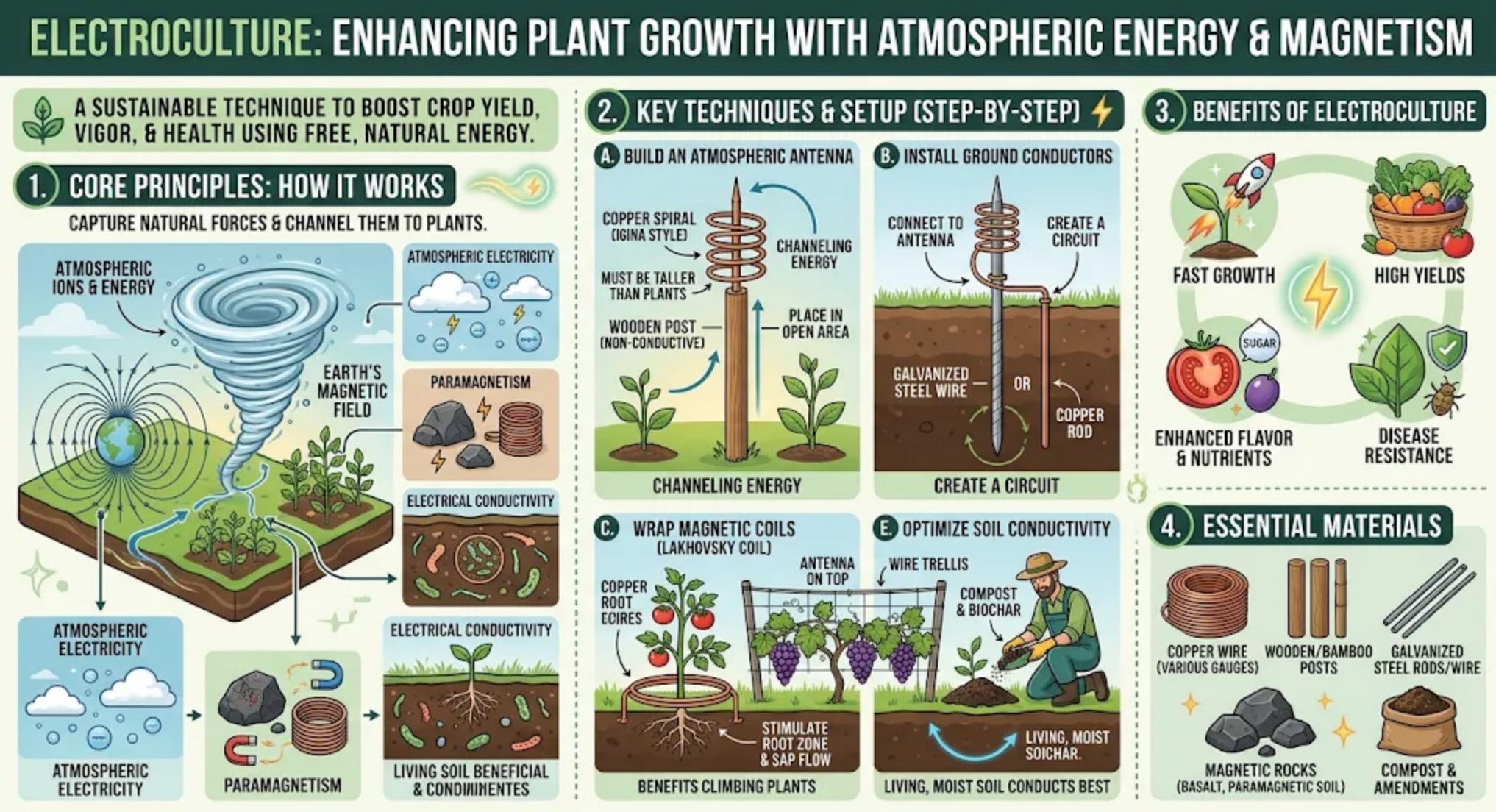
It’s any method of feeding a plant electricity instead of, or along with, fertilizer. The USDA’s bulletin opens with its own definition: practices “designed to increase the growth and yield of crops through electrical treatment, such as the maintenance of an electric charge on a network over the plants or an electric current through the soil in which the plants are growing.” Over the years, people have done that with charged wires strung over a field, with metal plates buried in the dirt, with tall poles that pull electricity down out of the air, and with copper coils pushed into a garden bed.
The air does have electricity in it. On a clear day, the bulletin puts the natural voltage difference between the ground and the air at “of the order of 100 volts per meter” of height. Every plant grows up through that field, and electroculture is the idea that you can turn it up.
Who tried it first?
Pierre Bertholon, a French priest and physicist, wrote a book in 1783 called De l’électricité des végétaux, the electricity of plants, and he built a device he called an electro-vegetometer to draw electricity from the air down to his plants. According to Justin Christofleau’s 1920s book, a Russian researcher named Spechnoff later improved Bertholon’s device and reported 62 percent more oats, 56 percent more wheat, and 34 percent more linseed.
In the 1880s and 1890s, Brother Paulin, who ran the agricultural institute at Beauvais, in France, put up what he called a geomagnetifer, a tall metal pole that worked something like a lightning rod in reverse, collecting electricity from the air and sending it into the soil. George S. Hull, a Pasadena physician, gathered these experiments into a book called Electro-Horticulture in 1898. According to Hull, a committee that reported on Paulin’s work found that one geomagnetifer, 28 feet high, made “its influence felt over a radius of sixty-five feet,” that potatoes inside that circle yielded 50 to 75 percent more, and that the committee awarded Paulin a special medal. In his vineyard, Hull writes, the grapes came in earlier and sweeter, with about five percent more sugar.
Then came the northern lights. A Finnish physicist named Selim Lemström went north on expeditions between 1868 and 1884 to study the aurora, and he noticed that crops near the Arctic grew fast in spite of the short growing season and the weak sun. He decided the same electrical currents that light up the polar sky were feeding the plants. He wrote that the needles on pine trees and the bristles on barley act “in the same fashion as metallic points,” pulling electricity out of the air, and he reported tree rings from 60 to 67 degrees north with “a periodicity in full agreement with the periods of the sun spots and the auroras,” work he said was “not yet published.” Once he strung charged wires over his own test fields, he put the increase at 45 percent “for land of average fertility,” which he gave as the smallest figure he’d stand behind. He also wrote that on poor soil the gain was “so small as to be scarcely perceptible.” His results are in Electricity in Agriculture and Horticulture, published in London in 1904.
So by 1900, three men in three countries had each reported a gain from feeding plants electricity from the air, and one of them had a medal for it.
What did Christofleau promise?
Justin Christofleau was a French inventor who sold electroculture equipment from about 1910 until he died in 1939, and his book, Electroculture, was translated into English in the 1920s and sold through agents as far away as Perth, Western Australia. The title page lists him as a “Knight of Merit of Agriculture” and a “Gold Medallist of Society of Encouragement for National Industries.” He sold the device he wrote about, so his stake is out in the open.
His device was a metal mass on a pole at least 20 feet high, with one point aimed at the sky and wires running through the soil underneath. The book says the apparatus “makes its own electricity at no cost whatever, and will last for a man’s lifetime.” He reported oats seven feet tall in a field that was “not manured nor irrigated,” potato plants six feet eight inches high with 30 to 85 tubers each, and vines “badly attacked by Phyloxera,” the root louse that wiped out much of Europe’s wine country in the 1800s, that were “heavily laden with enormous bunches of very sweet grapes” after three years.
And he said out loud who would lose. The book promises “the economising of the immense sums of money which are being spent annually for fertilizers,” and in capital letters: “IN THE FUTURE THE NEED OF CHEMICAL MANURES TO FERTILISE OUR LAND WILL BE GREATLY MINIMISED.”
Then, according to one account, his devices got pulled off a shelf in Paris. In 2010, Roland Wehrlen and Maxence Layet published Électroculture et énergies libres, and in its first chapter they report a letter that an environmental club in Bordeaux received on August 15, 1975. It came from a man over ninety who said he had worked for the Bureau de Renseignements Agricoles, the information office of the nitrogen fertilizer industry’s trade association. He wrote that, about forty years earlier, he’d been sent to the BHV, the big department store in Paris, to “semer le doute,” sow doubt, about Christofleau’s devices and get them pulled from the garden department. The book doesn’t name him. Wehrlen and Layet call his letter “le seul élément probant,” the only solid piece of evidence they found for the smear campaign. The man was over ninety and still wanted it on the record.
What did the USDA test, and who ran it?
The USDA’s test was run by government scientists at a government farm, paid for by the federal budget. Briggs and three colleagues, A. B. Campbell, R. H. Heald, and L. H. Flint, started in 1907 and ran the big field trials at the Arlington Experiment Farm, in Rosslyn, Virginia, from 1911 to 1918. Over half-acre plots of wheat, rye, soybeans, and cowpeas, they hung a wire network five meters up and charged it to about 50,000 volts, mostly overnight. In one plant-house trial, the charged screen coated the cowpeas with “soot and dust” so thick that the plants didn’t thrive, and the researchers “finally discarded” the whole set. In 1917, they grew wheat on the same plots with no electricity at all, to see how much the soil itself varied.
Their summary: “These experiments do not show any well-defined increase in yield due to electrical treatment.”
The same bulletin reviews everybody else’s work, and that’s where it gets interesting. It reports that “the electroculture committee of the British Ministry of Agriculture and Fisheries recommends (1923) the continuation of experiments with high potential discharge.” It walks through the British field trials run by V. H. Blackman, where 21 of 33 trials showed an increase, for an average of 14 percent, and it says that “such an increase would seem sufficient to be of promise from an agricultural standpoint.” Then it spends pages questioning his soil.
It lists Paulin among those who “reported favorable results,” and in the bibliography, next to Paulin’s 1892 report, it says “[Not seen.]” So the bulletin that told American farmers to skip electroculture lists the medal-winning French work without having read it.
It also reports that, in 1878, a French researcher named Louis Grandeau grew wheat inside a grounded metal cage, a Faraday cage, which blocks the air’s natural electricity. His caged plants came out “weak and slender.” Six stalks grown in open air weighed 6.57 grams, and six grown in the cage weighed 4.95. Grandeau concluded that tall trees shade the plants under them electrically, too, and slow their growth. The bulletin answers him with Briggs’s own earlier work: Briggs and Homer Shantz had grown hundreds of pots under a grounded metal screen while they measured how much water plants use, and Briggs’s team says those plants were “almost without exception superior” to the ones outside.
And then there’s Ross, a man in New York who buried a copper plate and a zinc plate in his potato field before 1844 and reported bigger potatoes. The bulletin’s comment: “The supposed beneficial effect is rendered doubtful through the subsequent discontinuance of so simple a treatment.” So Ross quit, and eighty years later the USDA used the quitting as a reason to doubt the potatoes, without knowing why he quit.
Who was Lyman Briggs?
Briggs was a soil physicist who had worked for the Department of Agriculture since 1896, and he became director of the National Bureau of Standards in 1933. On October 21, 1939, he chaired the first meeting of the Uranium Committee, which Roosevelt set up after Einstein’s letter about uranium. In The Martians of Science, the historian István Hargittai tells how, in the spring of 1940, a physicist named Louis A. Turner worked out that uranium-238 could be turned into plutonium, sent his paper to Physical Review, and asked whether he should hold it back. There was still “no mechanism in place, apart from voluntary action, for deciding whether manuscripts should be withheld from publication.” So “Lyman Briggs set up a new committee.”
Later, when Alexander Sachs, the man who had delivered Einstein’s letter to Roosevelt, asked Briggs about inviting Leo Szilard and Enrico Fermi to a meeting about the uranium project, Briggs said, “Well, you know, these matters are secret and we did not think that they should be included.” Szilard and Fermi had come up with the secret matters themselves. (Hargittai says there are “multiple ironies in this,” which is polite of him.)
So in 1926, Briggs signed the bulletin whose bottom line was “not recommended.” Fourteen years later, he set up the committee that decided which physics papers to hold back from print. The electroculture report went out to the public at ten cents a copy. The uranium work he was put in charge of went into secrecy.
Why would anyone want electroculture forgotten?
Look at the timing. The first factory to make synthetic ammonia for fertilizer with the Haber-Bosch process opened in Oppau, Germany, in 1913, the same decade the USDA was hanging its wires at Arlington. By the time Bulletin 1379 came out in 1926, nitrogen was something farmers bought every season. Electroculture asked them to buy a pole and some wire once. Christofleau said that in print, Lemström put his gain at no less than 45 percent on average land, and the British trials the USDA itself reported averaged 14 percent. A method that cheap, with numbers like that, is bad news for anyone selling yield by the bag.
The fertilizer business shows up in two separate accounts. One is the 1975 letter about the BHV. The other comes from Austria, and I saw it via Matt Roeske, who runs Cultivate Elevate. Roeske says the forester Viktor Schauberger put copper into the soil and got harvests 17 to 35 percent bigger, until the local agricultural society shut it down. Both details come from Living Water, Olof Alexandersson’s book on Schauberger. Alexandersson writes that Schauberger covered the cutting surface of an iron plough with copper sheeting and tested it on fields split between iron and copper, and that the copper side “showed a 17-35 per cent increase in harvest.” A large estate near Salzburg, Farmleiten-Gut Heuberg, reported 50 percent. In Schauberger’s own field notes, collected in The Fertile Earth, one 1947 oat trial came in 58 percent higher on the copper half.
In 1948, Schauberger signed a contract with a Salzburg company to make the ploughs. Alexandersson writes that a high official from Salzburg’s treasury office drove up in an elegant car and told him, “I have an agreement with the nitrogen industry whereby if I can stimulate the farmers to use more nitrogen than usual I receive a royalty for each sack being sold.” If farmers switched to copper, the official said, “the demand would permanently diminish,” so he wanted royalties from the ploughs to make up for it. Schauberger called him “a greedy rascal.” After that, the company canceled the contract, and “representatives from the local agricultural society also started to warn farmers against using the copper plough as it could cause over-production which would give lower prices.” Production stopped. Schauberger and the engineer Franz Rosenberger still got Austrian patent 166644 for copper-covered farm tools in August 1950.
Two countries, two decades apart, and in both stories a man tied to the nitrogen business shows up to stop a cheaper way of growing more food.
Who else kept finding the same thing?
The idea kept coming back, from people who ostensibly had never heard of each other.
In 1924, at the Salpêtrière hospital in Paris, the Russian-born engineer Georges Lakhovsky infected geraniums with Bacterium tumefaciens, which causes tumors on plants, and then put a ring of copper wire around one of them. The account of his experiments, collected in The Lakhovsky Multiple Wave Oscillator Handbook by the Borderland Sciences Research Foundation, says the ringed plant dropped its tumor, and the handbook prints photos of it a year and three years later, healthy and flowering. Lakhovsky believed every living cell is a tiny electrical circuit that vibrates, and that the copper ring helped the plant’s cells hold their own frequency. His later book is The Secret of Life.
Philip S. Callahan worked for the USDA itself. According to the catalog entry for his papers at the National Agricultural Library, he became project leader for insect biophysics at the USDA’s grain insect research laboratory in Tifton, Georgia, in 1962, moved to the USDA’s Insect Attractant and Behavior Laboratory in Gainesville, Florida, in 1969, and retired from the USDA in 1986. He had served in Ireland as a radio technician in World War II, and he came to believe that the old Irish round towers worked as antennas, collecting energy from the sky for the fields around them. He wrote Paramagnetism: Rediscovering Nature’s Secret Force of Growth about rocks and rock dusts that respond to a magnet and, he argued, help plants grow. According to James W. Lee’s book The One World Tartarians, Callahan’s breakthrough came when he noticed the towers’ slight three-degree taper and thought how much they looked like insect antennae. So decades after Bulletin 1379, a USDA scientist spent years on the idea that energy from the sky feeds crops.
And then there are the seeds. In Seed of Knowledge, Stone of Plenty, published in 2005, John Burke and Kaj Halberg write that in 1993 Burke was helping develop a seed treatment invented by W. C. Levengood, a Michigan biophysicist, that exposed seeds to “a special type of carefully controlled shower of electrons,” something “more akin to static electricity” than radiation. Burke was in the business of selling that treatment, so he had a stake in it, and he says so. He writes that treated seed in Chinese provinces with acid soil produced “more than twelve percent extra soybeans per acre and thirty percent more tomatoes,” that treated carrot seed in Ontario cut the number of misshapen carrots in half after a flood, and that ninety percent of farmers who tried it paid to have it done again the next year. That work sent Burke and Halberg to ancient sites with the kind of instruments the US Geological Survey uses, and they write that they found “unusual concentrations of geo-magnetism, electrical ground currents, and electric charge in the air” at the mounds and pyramids. In Guatemala, they left corn seed on top of the Lost World Pyramid at Tikal, and back in Michigan, Levengood germinated it. They write that the seed from the pyramid on its most electrically active day grew “drastically improved” compared with seed kept in their hotel room.
UPCOMING WORKSHOPS:
Shift Your Timeline - Live on Zoom
Dates:
Sunday, November 29, 10AM to 7PM Eastern
Sunday, December 20, 10AM to 7PM Eastern
In this one-day live workshop, the audio guides your body into deep stillness while your mind stays fully awake and alert, opening you into a state of expanded consciousness. Then, we move into a state outside of time. While you’re in that state, you focus on embodying the life you want instead of the one you’re currently headed toward. The idea is that choosing it clearly, in that state, makes it more likely to happen.
Starfire Signals - Live on Zoom
Dates:
Monday, November 30, 8 PM to 10 PM Eastern
Tuesday, December 8, 10 AM to Noon Eastern
Monday, December 28, 8 PM to 10 PM Eastern
In this bimonthly live class, the audio settles your body into deep rest while keeping your mind fully alert, opening the door to expanded consciousness. In that relaxed state, you practice noticing what your intuition is telling you, and writing it down before you second-guess it. Over time, that makes it easier to trust what you’re sensing and helps you to tap into your own guidance on command.
Starfire Spark - Live on Zoom
Dates:
Thursday, November 19, 8:30 PM to 10:30 PM Eastern
Thursday, December 17, 8:30 PM to 10:30 PM Eastern
In this monthly live class, you listen to special audio that helps your body relax deeply while your mind is still wide awake, tapping into expanded consciousness. Then, still on the call, you make something — a timed sprint where you write, play, or create without stopping to judge it. Some meetings, you’ll share one small piece of what you made with the group. Most meetings, you leave with something new that didn’t exist before class started.
Did anybody try radioactivity on plants?
Yes, in the same years, and the uranium thread runs right through it. The newest version of the idea also comes from Matt Roeske. He says that if you water your plants from uranium glass, the yellow-green glass that glows under a black light, “your plants will grow three times the size,” and that food and flowers keep three times as long in it. I haven’t found a controlled test of that one yet. What I did find is a forgotten chapter of people putting light and radioactivity on plants, and a lot of them reported results.
Roeske also has an 1876 book, printed in blue ink, that says plants behind blue glass “will grow three to four times the size.” That’s General Augustus Pleasonton, a West Point graduate and a militia general during the Civil War. In the 1860s, he built a grapery where every eighth pane was blue, and he reported that twenty vines in their second year produced 1,200 pounds of fruit. He addressed his book, The Influence of the Blue Ray of the Sunlight and of the Blue Color of the Sky, to the Philadelphia Society for Promoting Agriculture, and he had it printed on blue-tinted paper because he believed blue ink on blue stock was easier on the eyes. A blue glass craze followed, and in 1877 one Massachusetts company was making 3,000 square feet of blue glass a day. That February, Scientific American, which Munn and Company published alongside its patent agency business, ran an unsigned piece called “The Blue Glass Deception”, saying the glass “acts purely as a shade for decreasing the intensity of the solar light.”
In 1909, C. Stuart Gager, a botanist at the University of Missouri, reported in Popular Science Monthly that radium rays “act as a stimulus to the various physiological processes of plants.” In one of his tests, lupine roots exposed to radioactive air grew 28.66 millimeters in 24 hours, against 16.08 for the roots he left alone. Too strong a dose, or too long, and he got “a retardation, or complete inhibition of function, or the death of the plant.” So the dose was everything.
In Prague, the agricultural chemist Julius Stoklasa reported that radioactivity made the nitrogen-fixing bacteria in soil more productive, and French companies sold “radioactive” fertilizers on the strength of work like his. One 1919 ad was for a product called Excitor Agral, and in 1922 Lucien Fournier published a whole book called Les stimulants radio-actifs en agriculture, radioactive stimulants in agriculture. The French government took it seriously enough that in 1921, the Ministry of Agriculture and the fraud office had Irène Curie, Marie’s daughter, build an electroscope to measure how radioactive those fertilizers were.
In England, Martin Sutton, of the Suttons seed company in Reading, studied radioactive ores and residues on plants in a test his own company ran and published, and an unsigned review in Nature, in July 1916, said that “radium compounds have no sufficient effect on plant growth.” Later, a review in Health Physics, the journal of the Health Physics Society, the professional group for radiation protection, came out of the University of Rochester, home of an Atomic Energy Project that reported to the Atomic Energy Commission. The Energy Department’s own archive doesn’t list the review’s authors or who paid for it. It went through 207 references and found reports of taller plants and bigger yields from low doses, and it called the effects “usually small, being about 10% of control values,” “often” not reproducible, and “None has been independently confirmed.”
Wilhelm Reich put radioactivity and atmospheric energy together. He built orgone accumulators, boxes he believed gathered a life energy from the atmosphere, and in January 1951, at his lab in Maine, he put a one-milligram needle of radium inside a nest of them. He called it the Oranur Experiment, and the table of contents of his report lists “Oranur Sickness” and an “Atmospheric Oranur Chain Reaction.” In his own account, Maine’s blueberry growers later asked him to bring rain with his cloudbuster. The word accumulator goes back to Lemström. In 1997, the Journal of Borderland Research called Lemström’s 1882 discharge coil “the world’s first Auroral Accumulator” and named “Reichenbach, Tesla, Reich” in the same breath.
Some of the scientists who argued for low doses kept radioactivity close to home, too. T. D. Luckey, who chaired biochemistry at the University of Missouri’s medical school, the same university where Gager had tested radium on plants, wrote Hormesis with Ionizing Radiation in 1980. According to a 2011 profile from the American Nuclear Society, he kept a large chunk of uranium ore on his bedside table.
What happened to radium heat?
Allegedly, the reason radium fireplaces were nixed from public memory was because it would break the false energy scarcity models. When I went looking, I found that the X-Radium was a real product. The Novelty Manufacturing Company of Jackson, Michigan, put it on the market in 1904, according to Hardware Dealers’ Magazine, and the researcher who writes as KorbenDallas at Stolen History quotes its ad saying it “requires no fuel”. The Henry Ford museum has one and calls it a foot warmer that ran on “a special patented brick,” one that users “had to remember to heat” before a trip. Radium does give off heat with no fuel at all. Pierre Curie and Albert Laborde measured about 100 calories an hour from a single gram of it in 1903, and it keeps doing that for centuries. KorbenDallas calls his own evidence “rather circumstantial,” and he quotes Marie Curie saying that “the scarcity and cost and danger of radium will keep it in the hands of the experimenter.”
Who still bathes in radium?
The Bureau of Standards, Briggs’s employer from 1920, kept the national radium standard, and the radium it measured came out of the same ground as uranium glass. Marie Curie got her radium from the leftovers of uranium mining in Jáchymov, in what’s now the Czech Republic, and uranium from those mines also colored Bohemia’s glass. In 1912, the town opened the Radium Palace, which its owners say was one of the best hotels in Europe, so people could “drink and bathe in the waters, inhale the air, and be cured.” Curie visited in 1925, and it’s still open. In the Austrian Alps, the Gastein Healing Gallery takes patients into a tunnel miners once dug looking for gold, where the air has radon in it, and as of 2012 it saw about 12,000 patients and visitors a year. Health insurers in Austria and Germany sometimes pay for it.
Any treatment that’s cheap - like bathing in a spring - is demonized, and then you end up finding out the elites still use it above what they push on us. Gastein’s own history lists Emperor Wilhelm I, Emperor Franz Joseph, and Empress Elisabeth, the one everybody called Sisi, among the guests who came for its waters.
Roeske says radium is what makes hot springs hot, and that the very wealthy used to go to the hot springs. Gastein’s guest list backs up the second part. On the first part, a 1909 US Geological Survey bulletin measured Yellowstone’s waters and figured that no more than 1 percent of the heat for its hot springs came from the radium in the rock, though it found the waters of Hot Springs, Arkansas, “probably fully as active.” In 2011, the KamLAND detector in Japan, a collaboration that includes the Energy Department’s Lawrence Berkeley lab, counted particles coming up out of the earth and put radioactive decay at about half of the planet’s internal heat. By those counts, radioactivity heats the rock the springs run through, even if the radium in the water doesn’t do it alone.
In America, radium water got filed as quackery. Eben Byers, a Pittsburgh steel company president and a former US amateur golf champion, drank about three bottles a day of Radithor, radium in distilled water at a dollar a bottle, from December 1927 until 1930, when his teeth started falling out. By the time a Federal Trade Commission investigator interviewed him, most of his jaw had been removed, and he died in 1932. Today the museum of Oak Ridge Associated Universities, which runs a science institute for the Energy Department, files Radithor, and the Revigator, a crock lined with radioactive ore for your drinking water, under “Radioactive Quack Cures.”
Roeske drank radium water, almost 300 days of it by his count, and he said his “energy’s through the roof.” He points people to Modern Rejuvenation Methods, a 1926 book by Charles Evans Morris, MD, from Scientific Medical Publishing in New York. He says Morris describes “20,000 doctors in the 1920s” healing people with radium water, and that the radium material fills the last 80 pages. The Revigator started as Ralph W. Thomas’s jar in Southern California around 1921. Thomas lined it with radium ore he got from a miner in the Colorado mountains, and his 1921 ad called it “the greatest remedy and cure ever discovered for each and every disease.” In 1928 the National Bureau of Standards tested water from the jar and found it radioactive, and in 1930 the Federal Trade Commission filed a complaint over the company’s claims, including that the government endorsed it.
Roeske also says radium healed lupus in Paris and that a blind girl in New York began to see. Both stories are in old newspapers and medical histories. In 1901, Pierre Curie gave a packet of radium salts to Henri Danlos, a doctor at the Hôpital Saint-Louis in Paris, and Danlos used it on a patient with lupus. La Revue du Praticien, a French medical journal, calls it the first curietherapy in history and says the lupus was the tuberculous kind, an infection of the skin. A history page hosted by France’s nuclear physics institute calls it lupus erythematosus, the autoimmune kind. And on August 24, 1903, the New York American ran the headline “She That Was in Darkness Tells How by Radium She Saw the Light,” according to Matthew Lavine’s history of radium in the Bulletin for the History of Chemistry.
What does homeopathy have to do with it?
It’s the same thing with homeopathic medicine and allopathy. In 1910, the Carnegie Foundation published Abraham Flexner’s report on American medical schools, and according to a 2021 history by D. Clark, it discredited “nearly all homeopathic and eclectic” schools. Public funding and enrollment at those schools fell, and by the middle of the century they were nearly gone. By that time, Abraham’s brother, Simon Flexner, already ran the Rockefeller Institute. Frederick Gates, the adviser who urged John D. Rockefeller to found the Institute, wrote that homeopathy was “simply a reaction and protest against the powerful and injurious drugs” of regular medicine, though he wasn’t sold on either side. And Rockefeller’s own medical adviser, Hamilton Biggar, was a Cleveland homeopath the Dittrick Medical History Center calls Rockefeller’s “intimate friend.” In England, Peter Fisher spent 16 years as physician to Queen Elizabeth II, in the one royal post that gave the whole family entirely homeopathic and complementary care. In December 2023, King Charles put Michael Dixon in charge of his medical household, a doctor who has written that “the effects of homeopathy may be real.” Meanwhile, NHS England stopped paying for homeopathy for everybody else in 2017, and its chief executive called it “at best a placebo.”
Carnegie money went into what schools taught about society, too. The Carnegie Corporation paid for a five-year investigation by the American Historical Association’s Commission on the Social Studies in the Schools, and in his 1934 preface, the chairman, A. C. Krey, thanked its trustees, “whose financial aid made possible the whole five-year investigation.” The commission’s Conclusions and Recommendations told the country’s social studies teachers that “the age of individualism and laissez faire in economy and government is closing and that a new age of collectivism is emerging,” with “a corresponding enlargement of the functions of government” and “an increasing state intervention in fundamental branches of economy previously left to individual discretion and initiative.” Edmund E. Day, the Rockefeller Foundation’s director of social sciences, served on the commission and declined to sign it.
What about uranium glass?
It goes back to Bohemia in the 1830s, where Josef Riedel gets the credit for making it first. For about a hundred years, people drank from it, served dinner on it, and in the case of red Fiestaware, ate off a glaze that was up to 14 percent uranium by weight.
Roeske says each kind of glass works on a different meridian in the body: manganese for depression, uranium for low energy, copper for fatigue and inflammation, and cobalt for brain fog. He says families brought out their special glassware on holidays, and he finds vintage pieces on eBay. The chemistry under the colors is real. The Museum of Fine Arts in Boston lists manganese oxide for violet glass, cobalt and copper oxides for blue, copper oxide for blue-green, and uranium oxide for yellow.
Then the government took the uranium. During World War II, it confiscated the Homer Laughlin company’s uranium stocks, which ended Fiesta red in 1943, and American uranium glass stopped from 1942 until about 1958. That’s the bomb program that grew out of Briggs’s Uranium Committee. When the glassmakers and potters got uranium back, it was depleted uranium, the leftover from enriching uranium for bombs and reactors. So American uranium glass went dark for about sixteen years while the program that started with Briggs’s committee had the uranium.
The Oak Ridge museum now tells you to “never use uranium glass as dinnerware or drinkware.” The federal analysis it cites puts the highest dose from uranium glassware at 1 to 2 percent of what the average American gets in a year, and that’s for the people who ship it, not the people who drink from it. The closest thing I’ve found to a test of the uranium-glass-and-plants idea is a bonsai grower who collected pond cypress seeds in January 2024, set two pieces of uranium glass beside one tray, kept a second tray as a control, and wanted to see whether he’d get mutants. The thread I found has no results, mutant or otherwise.
Japan never gave up on radioactivity at home. You can still buy a “hormesis stick” of radium ore to set beside your water bottle. In 2005, a company president, Yoshimasa Watanabe, made Radic Hot Spring Ware, cups and bowls with a thorium glaze “said to improve the taste of food or drink,” and he donated one to the Oak Ridge museum, which keeps it with its radioactive quack cures.
The luxury end never stopped either. Moser, the glassmaker in Karlovy Vary, a short drive from Jáchymov, supplied the Austrian imperial court and King Edward VII, and Leo Moser added a uranium-colored glass to the line in 1923. For the 100th anniversary of its Prague boutique, which Moser says has welcomed “members of royal families and heads of state,” the company brought the uranium color back. Its uranium Bar tumblers start at $719, and some of its uranium Maharani glasses are sold out.
Put it together and radium on your plants got “no sufficient effect” from a seed company in England and a fertilizer business in France, while radium in your drinking water became a quack cure. Radon in a spa tunnel is a covered treatment for patients in Austria and Germany, and uranium glass is a $719 tumbler in Prague.
As far as I can tell, the radioactivity didn’t change from one to the next. Who was selling it, and who was buying it, did.
Channeled messages posts go out to paid subscribers every day. Tarot, shufflemancy, numerology, runes, and meditation applied to the specific energies of the day, delivered directly to your inbox.
And the Pentagon?
The Arlington Experiment Farm closed around 1940, and the USDA moved its research to Beltsville, Maryland. In 1941 the War Department picked the farm site for its new headquarters, and because the tract had borders on five sides, the architects drew a five-sided building. Then Roosevelt moved the building to a site near the old Hoover Airport, because he didn’t want it blocking the view of Washington from Arlington National Cemetery. History.com puts the new site three-quarters of a mile south of the farm, and the Virginia Places site says about a mile. According to Live Science, by then there wasn’t time to come up with a new design, so it stayed a pentagon.
So the Pentagon got its shape from the farm where the government spent eight years growing wheat under electrified wires. The sources disagree about what happened to the land itself. The Lyster Dewey site, which tells the farm’s history, puts the Pentagon’s south parking lot where the farm used to be, and the Arlington Public Library’s history says the land became wartime housing for women and that “today Arlington National Cemetery occupies the land.”
What does any of this have to do with the Monroe Institute?
Bob Monroe started his lab in 1959, in a Quonset hut in Westchester County, New York, and according to Leslie France’s history of that lab, he and his helpers “built a copper screened cage, which they hung above ground and charged with high voltage ... with Bob in it ... just to see if it affected his ability to go out of body.” The answer, in the same history: “It did the first time, but not the second.”
Then in 1978, fifty-two years after the USDA wrote “not recommended,” the Institute’s newsletter, The Explorer, ran this headline about its new property in Virginia: “GROUND-BREAKING CEREMONIES, CHARGING OF SOIL SCHEDULED FOR JULY 3rd.” The issue never says how they charged the soil or what they hoped it would do. I also looked for any later report of that July 3 ceremony, in the Monroe material in my library and online, and haven’t found one yet.
What the article does say is that the New Land, 740 acres in Nelson County, would have “an agricultural research station in the Findhorn model,” growing vegetables year-round with techniques “including hydroponics, ultrasonics, ELF radiation and solar heated greenhouses.” Findhorn is the community Peter Caddy, Eileen Caddy, and Dorothy Maclean started in 1962 on the coast of Scotland, where they grew “40-pound cabbages” in “barren sandy soil” with instructions Maclean said came from the devas, her word for the intelligence behind each type of plant. ELF means extremely low frequency, the bottom end of the radio spectrum. So growing plants with electromagnetic fields was in the Institute’s plans in 1978.
In January 2020, the electrical engineer Ross Dunseath wrote in the Institute’s magazine, Journeys, about its copper wall room, an underground room lined with copper where volunteers are wired up for measurement. Healers there had “demonstrated DC voltages of 50 and 70 volts on demand,” and to make sure readings like that came from the people and not the weather, he listed “atmospheric electricity” as one of the things to rule out. “Fortunately,” he wrote, “the CWR is underground and the copper walls are backed by parallel panels of grounded aluminum acting as a shield.” He also wrote that lightning strikes miles away “induced small fast pulses in the recording.”
So Grandeau blocked the air’s electricity in 1878 and his wheat grew weak, Briggs blocked it in his screened pots and wrote that they grew better, and the Monroe Institute blocks it now to measure what people produce on their own. If you know what “charging of soil” meant in 1978, drop me a comment - I would love to hear it!
Where does electroculture stand now?
It’s back, with copper coils for backyard gardens sold all over the internet. One page by Robert A. Nelson, copied all over the web, lists Bulletin 1379 as a source next to the big percentages from the early experimenters.
The biggest modern test is China’s. In 2018, the Chinese Academy of Agricultural Sciences and other government institutes reported results from more than 3,600 hectares of government-funded vegetable greenhouses, after nearly three decades of study. Bare copper wires about three meters up, charged to as much as 50,000 volts, raised output 20 to 30 percent. They cut pesticide use by 70 to 100 percent and fertilizer by more than 20 percent. That’s the same setup the USDA ran at Arlington, wires overhead at about 50,000 volts, and the opposite result.
The backyard kind got its own test. In August 2025, four researchers at Marquette University, paid by the National Science Foundation, grew kale, mustard greens, turnips, and beets in one-gallon pots under LED lights for eight weeks, ten plants per treatment, with and without copper coils. They reported “no consistent evidence that passive electroculture is beneficial,” though the turnips with buried copper did grow bigger, and they measured only about 2 millivolts going into the soil. They tested small coils in pots indoors, not the charged wires China and the USDA used.
There’s also a June 2025 preprint by three researchers in Dhaka, Bangladesh, from a pharmaceutical sciences department and an electrical engineering department. It says its experiments found faster germination, stronger roots, and bigger yields, but it doesn’t give the crops, the numbers, or the voltages, and I didn’t find a funding statement in it. All 29 of its references are to the lead author’s own papers, on subjects like cyber harassment, blueberries, and liquid chromatography, and one of them is dated 2030.
Yannick Van Doorne, a French electroculture practitioner who sells kits and courses, writes that electroculture was “deliberately” pushed into oblivion starting around the 1930s (”de façon délibéré à partir des années 1930 environ”), and he asks “à qui profite le crime,” who profits from the crime. His answer is the agrochemical and fertilizer industry, and his evidence is the same 1975 letter.
How do you check it for yourself?
Start with who paid. The USDA test was run by government scientists, the Health Physics review came out of a university project working for the Atomic Energy Commission, the Marquette study was paid for by the National Science Foundation, and China’s greenhouses were run by government institutes. Christofleau, Van Doorne, and Burke sold the methods they wrote about. So read each one knowing who paid for it and who stood to gain.
Then read the original documents. Bulletin 1379 is free on the Biodiversity Heritage Library because the government published it. Read the conclusion, and then read the part where the authors review other people’s work, because that’s where the British committee’s 1923 call for more experiments is, along with the 14 percent and the “Not seen” next to Paulin’s name.
If you want to try electroculture in your own garden, plant two beds in the same soil, put your copper or your antenna on one, and keep notes on both. Next year, swap them, so you know whether it was the electricity or the dirt.
Why do you think electroculture dropped out of sight for most of the twentieth century? Tell me in the comments.
Further Reading
Ahmed, R., Tamim, M. T. R., and Dipu, K. (2025). The Science of Electroculture: A Revolutionary Approach to Boosting Agricultural Productivity. Preprint [online] Available here: https://doi.org/10.31234/osf.io/xtz6y_v1
Alexandersson, O. (1982). Living Water: Viktor Schauberger and the Secrets of Natural Energy. Gateway Books.
Alpentherme Gastein (n.d.). Healthful Gastein: A Valley with a Rich History. Alpentherme Gastein [online] Available here: https://alpentherme.com/en/therapy-health/healthful-gastein
American Historical Association, Commission on the Social Studies (1934). Conclusions and Recommendations of the Commission. Charles Scribner’s Sons.
American Nuclear Society (2011). Don Luckey versus Helen Caldicott: Low Dose Radiation Health Effects. ANS Nuclear Cafe [online] Available here: https://ans.org/news/article-705/don-luckey-versus-helen-caldicott-low-dose-health-effects
Blackman, V. H. (1924). Field Experiments in Electro-Culture. The Journal of Agricultural Science, Vol. 14, No. 2, pp. 240-267. Scilit [online] Available here: https://scilit.net/publications/8c4bb8268b4f99135a4192c747892852
Briggs, L. J., Campbell, A. B., Heald, R. H., and Flint, L. H. (1926). Electroculture. US Department of Agriculture Department Bulletin No. 1379. Biodiversity Heritage Library [online] Available here: https://www.biodiversitylibrary.org/bibliography/64768
Brown, T. J., ed. (1994). The Lakhovsky Multiple Wave Oscillator Handbook. Borderland Sciences Research Foundation.
Burke, J., and Halberg, K. (2005). Seed of Knowledge, Stone of Plenty: Understanding the Lost Technology of the Ancient Megalith-Builders. Council Oak Books.
Callahan, P. S. (1995). Paramagnetism: Rediscovering Nature’s Secret Force of Growth. Acres U.S.A.
Chier, M., Oakey, A., Budny, M. L., and Lemoine, N. P. (2025). Passive Electroculture Using Copper Rods Does Not Improve Yield in Home Container Vegetable Gardening. PLOS ONE, Vol. 20, No. 8 [online] Available here: https://journals.plos.org/plosone/article?id=10.1371%2Fjournal.pone.0329615
Christofleau, J. (c. 1927). Electroculture. English edition, Trouchet, Perth, Western Australia.
Cosset, J.-M. and Huynh, R. (2023). Grandeur, délires et polémiques: histoire du radium. La Revue du Praticien [online] Available here: https://www.larevuedupraticien.fr/article/grandeur-delires-et-polemiques-histoire-du-radium
Dittrick Medical History Center (n.d.). Homeopathy in Cleveland. Case Western Reserve University [online] Available here: https://artsci.case.edu/dittrick/?p=2219
Dunseath, R. (2020). Copper Wall Research at Monroe in 2020. Monroe Journeys, January 2020. The Monroe Institute via Internet Archive [online] Available here: https://archive.org/details/monroe-frequent-contributor-ross-dunseath/
Ferro, S. (2016). The 19th Century Manual That Claimed the Color Blue Could Cure All Ills. Mental Floss [online] Available here: https://www.mentalfloss.com/history/19th-century-manual-claimed-color-blue-could-cure-all-ills
Findhorn Foundation (n.d.). Our History. Findhorn Foundation [online] Available here: https://www.findhorn.org/history
France, L. (n.d.). Bob Monroe Research Laboratory. The Monroe Institute, excerpted history of the lab. Monroe Institute Research Files, via Internet Archive [online] Available here: https://archive.org/details/monroe-institute-research-files-toc
Gager, C. S. (1909). The Influence of Radium Rays on a Few Life Processes of Plants. Popular Science Monthly, Vol. 74. Wikisource [online] Available here: https://en.wikisource.org/wiki/Popular_Science_Monthly/Volume_74/March_1909/The_Influence_of_Radium_Rays_on_a_Few_Life_Processes_of_Plants
Gates, F. T. (n.d.). The Memoirs of Frederick T. Gates. American Heritage [online] Available here: https://www.americanheritage.com/memoirs-frederick-t-gates?page=13
Grall, Y. (n.d.). A Short History: First Steps in Nuclear Medicine. La Radioactivité, IN2P3 [online] Available here: https://laradioactivite-prod-en.apps.wok3.in2p3.fr/articles/phenomenon/radium_medicine
Hargittai, I. (2006). The Martians of Science: Five Physicists Who Changed the Twentieth Century. Oxford University Press.
HathiTrust (n.d.). Catalog Record: Modern Rejuvenation Methods. HathiTrust Digital Library [online] Available here: https://catalog.hathitrust.org/Record/009994981
Health Physics (n.d.). Radiation Hormesis in Plants. Health Physics, Vol. 5. OSTI [online] Available here: https://www.osti.gov/biblio/6273673
Henry Ford, The (n.d.). Footwarmer, circa 1900. The Henry Ford Digital Collections [online] Available here: https://www.thehenryford.org/collections-and-research/digital-collections/artifact/134776
History.com Editors (n.d.). The Pentagon. History.com [online] Available here: https://www.history.com/topics/us-government/pentagon
Hull, G. S. (1898). Electro-Horticulture. The Knickerbocker Press.
KorbenDallas (2020). 19th Century: Radium Heating Systems? Stolen History [online] Available here: https://www.stolenhistory.org/articles/19th-century-radium-heating-systems.27/
Lakhovsky, G. (1939). The Secret of Life: Electricity, Radiation and Your Body. Noontide Press.
Lavine, M. (2014). The Two Faces of Radium in Early American Nuclear Culture. Bulletin for the History of Chemistry, Vol. 39 [online] Available here: https://acshist.scs.illinois.edu/awards/OPA%20Papers/2015-Lavine.pdf
Layet, M., and Wehrlen, R. (2010, second edition 2014). Électroculture et énergies libres. Le Courrier du Livre [online] Available here: https://www.mollat.com/livres/807976/charles-maxence-layet-electroculture-et-energies-libres-les-bienfaits-de-l-electricite-et-du-magnetisme-naturels-pour-des-cultures-ecologiques
Lee, J. W. (2020). The One World Tartarians: The Greatest Civilization Ever Erased From History. Independently published.
Lemström, S. (1904). Electricity in Agriculture and Horticulture. The Electrician Printing and Publishing Company.
Lyster Dewey (n.d.). Arlington Experimental Farm. Lyster Dewey [online] Available here: https://www.lysterdewey.com/about/arlington-experimental-farm/
Monroe Institute of Applied Sciences (1978). New Land Construction Now Under Way. The Explorer, Vol. 1, No. 2. via Internet Archive [online] Available here: https://archive.org/details/mias-explorer-toc
Morris, C. E. (1926). Modern Rejuvenation Methods. Scientific Medical Publishing.
Moser (n.d.). Ultra-Limited Echoes Collection. Moser [online] Available here: https://www.moser.com/en/ultra-limited-echoes-collection
Museum of Fine Arts, Boston (n.d.). Glass Colorants. CAMEO [online] Available here: https://cameo.mfa.org/wiki/Glass_colorants
Musée Curie (n.d.). L’électroscope pour mesurer la radioactivité des engrais d’Irène Curie. Musée Curie [online] Available here: https://musee.curie.fr/decouvrir/documentation/l-electroscope-pour-mesurer-la-radioactivite-des-engrais
National Agricultural Library (n.d.). Philip S. Callahan Papers, 1911-2001. AGRIS, Food and Agriculture Organization [online] Available here: https://agris.fao.org/search/en/records/65ddfb250f3e94b9e5c8bbc4
Nature (1916). Radio-Activity and Plant Growth. Nature, Vol. 97, p. 411 [online] Available here: https://www.nature.com/articles/097411a0
Nelson, R. A. (n.d.). Electro-Culture (The Electrical Tickle). Rex Research [online] Available here: https://www.rexresearch.com/articles/elcultur.htm
Oak Ridge Associated Universities (n.d.). A Glowing Review of Uranium Glass. ORAU Museum Blog [online] Available here: https://www.orau.org/blog/museum/a-glowing-review-of-uranium-glass.html
Oak Ridge Associated Universities (n.d.). Fiestaware (ca. 1930s). ORAU Health Physics Museum Collection [online] Available here: https://orau.org/health-physics-museum/collection/consumer/ceramics/fiestaware.html
Oak Ridge Associated Universities (n.d.). Jáchymov: Cradle of the Atomic Age. ORAU Health Physics Museum [online] Available here: https://orau.org/health-physics-museum/articles/jachymov-cradle-of-the-atomic-age.html
Oak Ridge Associated Universities (n.d.). R. W. Thomas, the Revigator and the Thomas Cone. ORAU Health Physics Museum Collection [online] Available here: https://www.orau.org/health-physics-museum/collection/radioactive-quack-cures/jars/revigator-thomas-cone.html
Oak Ridge Associated Universities (n.d.). Radic Hot Spring Ware (2005). ORAU Health Physics Museum Collection [online] Available here: https://orau.org/health-physics-museum/collection/radioactive-quack-cures/products/radic-hot-spring-ware.html
Oak Ridge Associated Universities (n.d.). Radithor (ca. 1928). ORAU Health Physics Historical Instrumentation Museum Collection [online] Available here: https://orau.org/health-physics-museum/collection/radioactive-quack-cures/pills-potions-and-other-miscellany/radithor.html
Pleasonton, A. J. (1876). The Influence of the Blue Ray of the Sunlight and of the Blue Color of the Sky. Kessinger Publishing.
Reich, W. (1951). The Oranur Experiment. Orgone Energy Bulletin. Wilhelm Reich Museum [online] Available here: https://old.wilhelmreichmuseum.org/oranur_experiment.html
Roberts, J. (2026). What Was the Blue Glass Craze? Weird Science History [online] Available here: https://www.weirdsciencehistory.com/articles/the-1200-pounds-of-grapes-that-convinced-america-to-sit-under-blue-windowpanes
Roeske, M. (n.d.). Cultivate Elevate’s Podcast. Buzzsprout [online] Available here: https://www.buzzsprout.com/2439588/episodes
Royal College of Physicians (n.d.). Peter Antony Goodwin Fisher. Inspiring Physicians [online] Available here: https://history.rcp.ac.uk/inspiring-physicians/peter-antony-goodwin-fisher
Schauberger, V. (1999). The Fertile Earth: Nature’s Energies in Agriculture, Soil Fertilisation and Forestry. Trans. and ed. C. Coats. Gateway Books.
Schlundt, H. and Moore, R. B. (1909). Radioactivity of the Thermal Waters of Yellowstone National Park. US Geological Survey Bulletin 395. NPS History [online] Available here: https://npshistory.com/publications/geology/bul/395/sec4.htm
ScienceDaily (2011). What Keeps the Earth Cooking? ScienceDaily [online] Available here: https://www.sciencedaily.com/releases/2011/07/110717134819.htm
Scientific American (1877). The Blue Glass Deception. Scientific American Supplement, February 24, 1877. Project Gutenberg [online] Available here: https://www.gutenberg.org/files/19406/19406-h/19406-h.htm
South China Morning Post (2018). China Is Making Its Vegetables Grow Bigger, Faster and Stronger … Using Electricity. SCMP [online] Available here: https://www.scmp.com/news/china/science/article/2164365/electric-plants-powering-chinas-new-agricultural-revolution
Spa Business (2012). Mineral Spa: Radiate Health. Attractions Management [online] Available here: https://www.attractionsmanagement.com/Attractions-Management-magazine/Mineral-spa-Radiate-health/27706
Taylor, A. P. (2016). How the Pentagon Building Got Its Shape. Live Science [online] Available here: https://www.livescience.com/55637-how-pentagon-building-got-its-shape.html
UraniumGlass.net (n.d.). The Impact of World War II on Uranium Glass Production. UraniumGlass.net [online] Available here: https://uraniumglass.net/the-impact-of-world-war-ii-on-uranium-glass-production/
Van Doorne, Y. (n.d.). Electroculture : Énergies naturelles au Service de l’Agriculture. Yannick Van Doorne’s French site [online] Available here:
Virginia Places (n.d.). The Pentagon. Virginia Places [online] Available here: https://virginiaplaces.org/military/pentagon.html
Wikipedia (n.d.). Arlington Farms. Wikipedia [online] Available here: https://en.wikipedia.org/wiki/Arlington_Farms
Wikipedia (n.d.). Flexner Report. Wikipedia [online] Available here: https://en.wikipedia.org/wiki/Flexner_Report
Wikipedia (n.d.). Lyman James Briggs. Wikipedia [online] Available here: https://en.wikipedia.org/wiki/Lyman_James_Briggs
Personal readings, custom natal astrology charts, 1:1 coaching sessions with Demi, and more can be found here:
Excellent work as always. We were introduced to the copper wiring method in Germany a few years back and have heard some spooky and impressive things about it, especially since the guy arguing for it produced magnificent results in typical German fashion: aggravatingly patient trial and error.
Was also glad Oppau popped up, and not because this is so close to our home away from home when in Germany: the roots of the "Council of the Gods" may be found in the company you hint at here, BASF (remember their tape cassettes?). BASF teamed with Bayer, Hoechst, and a couple others to form Germany's most powerful chemical and pharma conglomerate, IG Farben. Tellingly, the first connections between companies were made after Carl Duisberg (Bayer) visited the US specifically to study the Trusts (Standard Oil, Alcoa, US Steel, etc) thriving there in 1903. Alliances then formed over the next few years...which ties in well with your conclusions and timelines on the Electroculture front.
Thank you for giving us mote esoteric history and other spiritual stuff as well.
We really can't hate the global elites enough.